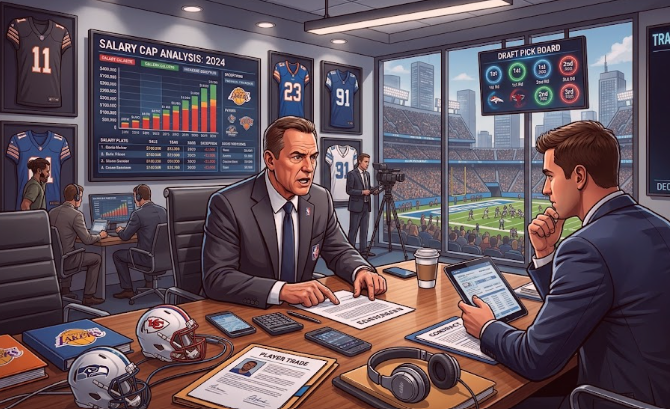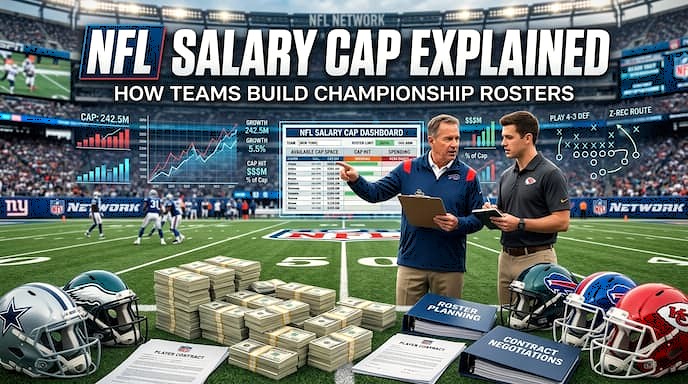

The National Football League, or NFL, is one of the most competitive sports leagues in the world. While headlines usually focus on star players, elite coaching staff, and winning game plans, there is also this other piece behind every good franchise. It’s NFL salary cap management, and honestly, it matters more than many people notice.
The NFL salary cap works like a balancing tool for the whole league. It helps stop rich teams from just purchasing every top talent. And it makes sure each franchise still gets a real shot at competing for the championship, not just the teams with the biggest budgets.
If you’re new as a fan, the salary cap can feel confusing. Analysts often talk about cap space, dead money, guaranteed contracts, and restructuring agreements. But those terms get thrown around fast, then people end up misunderstanding them anyway, and that’s where the confusion starts.
In this guide, you’ll find the full breakdown of the NFL salary cap explained, how it functions, why it was created, and the way teams use it to shape rosters that can actually win when it counts.
What Is the NFL Salary Cap?
The NFL Salary Cap is basically the highest amount of money each team can spend on player salaries during the league year.
In plain terms, the salary cap ends up as a spending limit for NFL teams.
Every single franchise has to work inside that financial boundary when they’re signing players, hashing out contract terms, and putting together the roster.
It also exists to promote a kind of competitive balance by keeping teams with deeper pockets from outspending their rivals in a major way.
If there weren’t a salary cap, a small group of richer franchises might end up dominating the league, because they could grab most of the best talent.
Why Does the NFL Have a Salary Cap?
The NFL brought in the salary cap to keep things more even, among teams, you know, not totally locked to the richer franchises.
Here, parity is basically about giving each organization a realistic opportunity to contend.
A few major aims show up through the salary cap setup, even if it sounds boring on paper. like:
Competitive Balance
The salary cap supports the idea that talent moves around the league, instead of being clumped up on a handful of teams.
Financial Stability
Teams have to handle their spending carefully, and that helps protect the long-run fiscal health of clubs.
Fan Engagement
If more squads stay within striking distance, then supporters keep showing up, and league-wide attention remains steady.
Fair Competition
The salary cap lays down a more level environment, where winning often reflects careful strategy, not unlimited expenditures.
All these elements are one reason the NFL has become among the most successful pro sports leagues globally.
How Is the NFL Salary Cap Determined?
The NFL salary cap is worked out by using league revenue.
Then, the league, together with the NFL Players Association (NFLPA), discusses and decides how football-related income gets split between owners and players, ok not perfectly evenly, but in a formal way.
That money usually comes from a few places, like
- Television contracts
- Streaming rights
- Ticket sales
- Sponsorship arrangements
- Merchandise sales
- Licensing agreements
A certain percentage of this revenue is set aside for player compensation.
After that, the math leads to the salary cap figure for each season.
So when overall NFL revenues go up, the salary cap usually goes up too.
This is one reason teams today can often move a little more freely with money compared to a decade ago.
What Counts Against the Salary Cap?
Lots of fans think the salary cap is only about player salaries, and that’s it, like nothing else matters.
But really, a handful of compensation types can mess with a team’s cap situation.
Base Salary
This is the basic amount a player earns during the season.
The base salary counts against the cap for the year it gets paid.
Signing Bonuses
Teams often offer a signing bonus when a player agrees to a deal.
Instead of taking the full amount at once, the NFL lets teams stretch the cap impact across the contract length.
That approach is usually called prorating the bonus.
Roster Bonuses
Some contracts include payments for staying on the roster through a certain date.
These roster payments still count toward the salary cap.
Workout Bonuses
A player may get extra money for showing up and participating in offseason training activities.
Performance Incentives
Other contracts add rewards when players hit specific benchmarks, like
- Passing yards, touchdowns
- Pro Bowl selections
- Defensive statistics
Depending on the structure, incentives may affect future salary cap calculations.

What Is Cap Space?
Cap space means the amount of money a squad can spend that stays under the salary cap
For instance:
If a team’s salary cap is $250 million, and player contracts come out to $220 million, then the club has $30 Million in Cap Space
Teams use available cap space to:
- Sign free agents
- Extend existing players
- Trade for players
- Handle injuries and roster changes
Managing cap space effectively is one of the most important responsibilities of NFL front offices.
Understanding Guaranteed Money
One of the most crucial ideas inside NFL contracts is guaranteed money, and honestly, it tends to get mentioned a lot.
Unlike in a few other pro sports leagues, NFL contracts are not always fully guaranteed; sometimes it is partial, and other times it is more limited.
Guaranteed money means a player will still receive a specific amount no matter what happens later, or at least that’s how it is written.
This can cover a few things, such as:
- Signing bonus money
- Salary amounts that are guaranteed
- Injury-based protection, sometimes called injury guarantees
For players, guaranteed money brings financial stability and a calmer horizon.
For teams, these guarantees are a serious financial pledge, not just a small detail.
What Is Dead Money?
Dead money is one of the most talked-about salary cap ideas.
Dead money means salary cap charges that are still on the books even after a player moves on from a team.
This often happens when :
- A player is released
- A player retires
- A player is traded
Since signing bonuses get spread across several years, teams might still have cap charges hanging around, even after the player is already gone.
Dead money can reduce a team’s financial flexibility and cause problems when they are rebuilding a roster.
How Teams Create Salary Cap Space
NFL teams use several strategies to manage the salary cap.
Restructuring Contracts
One common method is restructuring player contracts.
This often involves converting salary into signing bonuses, which spreads cap charges over multiple years.
Releasing Players
Teams sometimes release veteran players to reduce future salary obligations.
Renegotiating Contracts
Players and teams may agree to modified contracts that improve financial flexibility.
Extending Contracts
Extensions can spread salary cap charges over additional years.
Trading Players
Trades may help teams reduce salary obligations and create additional cap space.
Successful franchises often use a combination of these strategies.
The Risks of Salary Cap Management
While some clever finance maneuvers can keep teams competitive, they also bring certain risks in tow.
Some organizations shift salary cap burdens into later seasons, just to stretch their current championship window. And yes, it can look smart at first.
It tends to work best if the club actually wins the championship.
Still, the bill can show up later, often in messy ways.
You usually see issues like:
- Huge dead money amounts
- Older rosters that lose speed
- Less flexibility for future moves
- Challenges in landing young standout players
Finding the right balance between immediate wins and longer-term stability remains one of the toughest tasks in NFL management.
Teams Known for Smart Salary Cap Management
Several franchises have built fairly strong reputations for keeping the salary cap under control and not losing the thread.
New England Patriots
The Patriots repeatedly stayed in the hunt thanks to focused contract management and a few shrewd personnel calls.
Kansas City Chiefs
The Chiefs have managed to juggle big-name player agreements while still keeping a roster that can contend for a title.
Baltimore Ravens
The Ravens tend to draft with good judgment, and they avoid going overboard with free agency spending.
Pittsburgh Steelers
The Steelers usually lean into long-range planning and financial restraint.
In the end, these teams show how effective salary cap management can help produce lasting success.

How the Salary Cap Affects Championship Teams
Building a championship roster is more than just grabbing star players and calling it done.
Teams have to spread their resources across a lot of roles and situations, not only one glaring need.
Teams that last and win usually do a few things, pretty consistently, like:
- Draft talent with real discipline
- Turn young players into real contributors
- Don’t overpay declining veterans just because they used to be great
- Handle player agreements with a clear, long-term mindset
In many Super Bowl-winning dynasties, you can see that elite coaching and savvy financial planning move together, a pattern covered in our History of the Super Bowl: Champions, Records & Evolution guide.
Similarly, teams that keep their finances tight tend to create deeper rosters, which then helps them chase long playoff games, as explained in our How NFL Playoffs Work: Complete Guide for Beginners.
And yes, the salary cap colors nearly every roster move teams make during the entire season.
Salary Cap vs. Free Agency
Free agency basically lets players join new teams once their contracts run out, or whatever the contract says, ends.
The salary cap is a big deal for free agency because organizations have to keep enough cap room to actually sign players.
So even when a team really wants to land a star player, those cap limits can block the agreement, before anything serious even moves.
That ends up shaping a strategic setup where front offices must plan spending with extra attention, and they have to rank what matters most.
Common Salary Cap Myths
Myth 1: Rich Teams Can Spend More
False.
Every NFL team operates under the same salary cap rules.
Myth 2: Contracts Equal Cap Hits
False.
The structure of a contract often differs significantly from its cap impact.
Myth 3: Teams Can Ignore the Salary Cap
False.
All teams must remain compliant with league salary cap regulations.
Myth 4: Dead Money Is Actual Cash
Not necessarily.
Dead money refers to salary cap accounting rather than immediate cash payments.
Understanding these concepts helps fans interpret contract news more accurately.
Frequently Asked Questions
What is the NFL salary cap?
The NFL salary cap is the maximum amount a team can spend on player compensation during a league year.
Why does the NFL use a salary cap?
The salary cap promotes competitive balance, financial stability, and fair competition.
What is cap space?
Cap space is the amount of money a team has available under the salary cap.
What is dead money?
Dead money refers to salary cap charges that remain after a player leaves a team.
Can teams exceed the salary cap?
No. NFL teams must comply with league salary cap regulations.
Final Thoughts
The NFL salary cap is one of the most important systems in professional football; it affects roster construction, player agreements, free agency calls, and the long-term plans of a franchise. At first, the rules can feel a little tangled, but learning the ideas behind cap space, guaranteed money, dead money, and contract restructuring gives a real understanding of how NFL teams actually run things.
Under every championship contender, there is a front office making hard financial choices. When teams get good at salary cap management, they can assemble strong rosters, keep star performers, and position themselves for steady success down the road. For fans, knowing the salary cap adds a new layer of appreciation because the league is not only about plays on the field, it is also about strategy in the books.