
The NBA is among the most entertaining professional sports leagues in the world and one of the most awaited events each season is the NBA trade deadline. Fans wait with bated breath for trade news, speculations, and huge trades that may change the fate of the whole team. Experienced basketball enthusiasts certainly know all about trades, but novice fans usually wonder about the essence of the NBA Trade Deadline Explained and its importance.
This guide to the NBA Trade Deadline Explained will give you all the necessary information about the trade deadline, from the definition and importance of it to the way it works.
If you’re new to professional basketball, check out our Complete Guide to NBA Rules for Beginners before learning about player trades.
What Is the NBA Trade Deadline?
NBA trade deadline refers to the last date during which NBA teams are allowed to trade players among each other during the regular season.
Prior to that date, teams have the liberty of enhancing their squads through additions to their ranks in terms of new players and draft picks. Following that, however, the teams are no longer permitted to trade any more until the start of the off-season.
This is because although waivers and sign-ups are possible even after the deadline, but no player-to-player trades are allowed till then.
As a result, the trade deadline becomes an exciting phenomenon for the entire league.
What is the Reason for NBA’s Trade Deadline?
NBA has established a trade deadline so that there is competitiveness within the league during the whole season.
If there had been no such thing as trade deadline, then the teams would have been able to keep on trading until just before the playoffs, thus allowing stronger teams to improve their line-ups.
A few reasons why there is a trade deadline include the following:
- Fairness in competition.
- Making strategic decisions by the teams.
- Creating team stability prior to playoffs.
- No frequent changing of the line-ups towards the end of the season.
Trade deadline is one of the busiest days in the NBA calendar.
What Is the NBA Trade Deadline Date?
NBA trade deadline is traditionally held in the beginning of February, although the specific dates vary from year to year.
The official trade deadline date is always announced by the league before the start of the regular season.
GMs of teams have several weeks for negotiation on possible transactions as the trade deadline is approaching.
The most dramatic time is during the last hours when most of the transactions take place close to the deadline.
Who Makes NBA Trades?
The negotiations for trading are done by the front offices of each of these teams.
The personnel that are most involved in this process include:
- General Managers (GM)
- Team Presidents
- Executive Personnel of Basketball Operations
- Owners of Teams (For Major Trades)
- Personnel of Salary Cap
While the head coaches may give opinions on what players the teams require, they do not get involved in negotiating the deals.
Why do Teams Trade Players?
The NBA teams trade for a number of reasons.
Strengthening the Team
A playoff team may make a trade for a player who will help in their area of need.
For instance, a team without shooting from the perimeter will trade for a three-point shooter just ahead of the playoffs.
Rebuilding for the Future
Some NBA franchises emphasize youth development over immediate success.
Such franchises trade away older players in return for:
- Draft picks
- Prospects
- Room under the salary cap
Learn more about long-term roster building in our Guide to theNBA Draft Explained.
Reducing Salary
The National Basketball Association uses the salary cap approach, which means that organizations are not free to spend whatever amount of money they wish to on contracts for players.
At times, organizations exchange expensive contracts in order to gain more financial freedom.
This gives them the freedom to sign up free agents or give contract extensions to existing players.
Resolving Team Chemistry Problems
Every trade does not necessarily involve numerical figures.
Sometimes, trades happen because of the following reasons:
- Incompatibility of playing styles
- Conflict in the locker room
- Change in the coaching philosophy
- Player-initiated trade
What Teams May Swap?
Most fans think that trading includes only players, but in reality, NBA trades may include other kinds of assets.
The assets that teams can trade are:
- Players
- Future draft picks
- Draft rights
- Monetary consideration (according to league rules)
- Pick swaps
In modern NBA trading, there is usually involved several teams and also many future draft picks.
Sometimes the big deals are made using up to five or even more players with many future draft picks.
Draft Picks in NBA Trades Explained
Draft picks are some of the most valuable assets in NBA.
The draft pick gives teams an opportunity to choose the young talented player joining the league.
Teams usually swap these picks in order to get the stars.
For instance:
The championship team might swap two future first round draft picks for getting All-Star player who will help them win right now.
And the rebuilding team gets the valuable assets for the future.
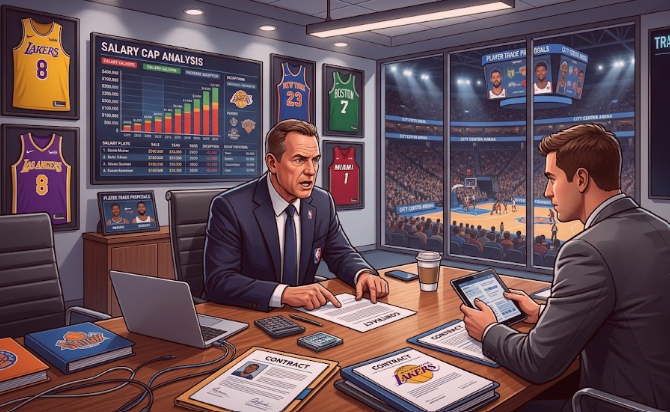
How Does the Salary Cap Impact Trades?
The salary cap is one of the most intricate things about NBA trading.
There are a number of financial guidelines in the NBA that dictate the legality of a trade.
In most cases, teams are required to match up contracts based on salary value.
This ensures that richer teams are not able to hoard all of the best players in the league.
Salary cap experts are usually employed to make sure that all trades conform to the rules of the league.
Are Players Able to Refuse Being Traded?
Players can usually not prevent themselves from being traded if they have an NBA contract.
There are some cases where:
- A no-trade clause is included in their contract
- They receive trade bonuses
- Their contracts provide additional protection
If a player has a no-trade clause, then they are required to give approval for all trades.
What Role Does the Salary Cap Play in Trades?
Perhaps the most complex aspect of trades in the NBA is the salary cap.
The NBA has established elaborate financial regulations which make a trade valid.
In most cases, teams have to exchange contracts whose salaries are equal in value.
That ensures rich teams don’t just accumulate all of the talented players in the league.
There are people who specialize in the salary cap to ensure that all trades meet the league’s financial regulations.
Are Players Allowed to Prevent a Trade?
Players who have a regular NBA contract can’t prevent a trade.
There are some contracts that may feature:
- No-trade clauses
- Trade bonus
- Other provisions
When you have a no-trade clause, you need to agree on the trade before it takes place.
The no-trade clauses are quite uncommon nowadays.
What Happens after the Trade?
After the agreement between the two teams on trading players, the NBA offices scrutinize every little thing about the trade.
They check:
- Player contracts
- Compliance with the salary cap
- Eligibility to trade
- League policies
If everything is in line with the NBA policies, the trade is finally approved.
Then, the players move to their respective teams and undergo medical checks as well as practice with their new teammates.
Multi-Team Trades
Not all trades involve only two teams.
Some trades may involve:
- Three teams
- Four teams
- Even five teams at times
These complicated trades help teams comply with the salary cap while getting the players they desire.
The three-team trades have grown in popularity in the recent years in the NBA.
Buyers vs. Sellers at the NBA Trade Deadline
At the approach of the NBA trade deadline, there are always two kinds of teams: buyers and sellers.
Buyers
These are those teams that believe they stand a good chance of making the playoffs or competing for an NBA title. They try to improve their roster by adding veterans who can have a positive effect immediately.
The buyer will give up his draft picks and prospects in exchange for some veteran. He aims to have the maximum chances to win now and not in future years.
Sellers
These are those teams that are not going to compete for the championship in the current year. Hence, instead of getting expensive veterans, they sell them to the teams in contention in exchange for younger players or draft picks.
To learn how rebuilding teams develop future stars, read our Guide to the NBA Draft Lottery Explained.
What is NBA Buyout Season?
Trade deadline doesn’t mark the end of all transfers.
Following the deadline, the teams have the option to release players in what is known as a buyout.
In the event of a buyout, a player and his team decide to end the term of the contract between them. As a result, the player becomes a free agent and has the option to sign up with another club.
This provides one more chance for playoff hopefuls to bolster their squad despite the fact that trading is no longer possible.
To illustrate, an experienced player who plays on a rebuilding team may choose to undergo a buyout to play with a playoff contender.
What is a Trade Exception?
Trade exception is one of the advanced terms in the NBA trades.
In simple terms, a trade exception is a mechanism that allows the NBA team to make trades at a later date without having to match the salaries immediately.
Instead of getting salary flexibility problems after making a trade, the team gets a financial exception that can help it make future trades.
Many front offices use the trade exception in order to have extra flexibility in their rosters and have the opportunity to make further trades.
The trade exceptions do not get much recognition from the fans but they are very important in managing a roster.
Can Injured Players Be Traded?
It is possible for injured players to be traded as long as they fulfill the eligibility requirements of the NBA.
Every trade involves an examination of the player in question after the deal is made. This helps in avoiding any hidden issues related to the medical condition of the player
Consequences of Missing Trade Deadline
Time management becomes one of the key aspects on the trade deadline day.
For a deal to be approved, it needs to be completed before the expiration of the NBA deadline. In case discussions are made after the trade deadline has expired, the deal will not be possible until the next trading period comes.
That’s why front offices tend to work non-stop before the deadline.
Sometimes fans see breaking news about certain trades being completed only several minutes before the deadline since many deals are made literally in the last minute.
Impact of Trade Deadline on Playoff Race
The NBA trade deadline can significantly affect the rest of the season.
One trade can:
- Enhance the chances for a championship win.
- Increase the odds of playing in the playoffs.
- Create additional depth for the team.
- Help to solve problems with defense or scoring.
- Change the league balance.
For instance, adding an excellent defender or an All-Star scorer to a strong team will make that team a serious champion contender.
On the other hand, rebuilding teams will become weaker after trading their experienced players.
ome of the Biggest NBA Trades on Deadline Day
In the history of the NBA, there have been many trades on deadline day that have altered seasons and the destiny of franchises.
Some of the best trades ever made include:
- All-Star caliber players
- MVP winners
- Future Hall of Fame players
- Several first round draft picks
These trades will define how well or poorly a team does in the coming years.
The trade deadline has seen many great trades in the history of basketball.
Explore our Greatest NBA Trades of All Time article to discover the biggest blockbuster deals in league history.
Myths About NBA Trade Deadline
There are several myths that exist regarding the working of the trade deadline.
Myth #1: All players can be traded.
This is not always true because there are some players who may be recently signed and hence not trade-eligible.
Myth #2: Only poor performing players get traded.
The good performing teams also trade players to make their good team even better.
Myth #3: Superstars are always traded.
It is always the blockbuster deal that involves a super-star that gets the maximum media coverage.
But actually, it is the role players, future draft picks and salary cap deals that constitute the majority of deadline transactions.
Myth #4: The trades are officially done on the same day.
All the trades need approval of the NBA league office to become official.
Advice for Understanding the NBA Trade Deadline
The NBA trade deadline can be hard to keep up with, particularly for new basketball fans. Below are some pieces of advice that will make following the deadline a bit easier:
- Make sure you know the standings for each team to see who is a buyer and who is a seller.
- Get familiar with basic concepts regarding the salary cap and contract rules in the NBA.
- Listen to credible sources covering the NBA rather than rumors.
- Remember that not all rumors turn out to be true.
- Picks in trades should also be taken into consideration as they are valuable assets.
- See how newcomers perform after being traded.
Following trade season regularly will make it easier for you to understand the reasons behind certain trades.
Why the NBA Trade Deadline Is Important
The NBA trade deadline isn’t just one single day; it is a whole period which marks a turning point for all NBA seasons.
Championship contenders use it to reinforce their rosters for the playoff run ahead.
For teams that are undergoing reconstruction, it gives them a chance to gather some valuable resources for the future.
Players get the chance to switch to a new team and play more competitive basketball.
And finally, fans have a chance to see one of the most exciting moments in the NBA schedule full of rumors, breaking news, and huge deals.
Regardless of whether you support your team or are a fan of the league overall, it will help you to become more excited about it.
If you’d like to understand how teams are built beyond trades, read our Complete Guide to NBA Free Agency Explained.
Frequently Asked Questions (FAQs)
What is the NBA trade deadline?
NBA trade deadline is the last day in the regular season for trading players and draft picks and other assets between teams.
Are trades possible after the deadline?
No. Trades will not be allowed after the trade deadline expires. However, teams will be able to sign eligible free agents or bring players through the buyout market.
Why do teams engage in trades?
Trading is done in order to strengthen the roster, rebuild, manage salary cap space, get draft picks or meet team’s particular requirements.
Can a player reject a trade?
Most of the players cannot reject trades. But the ones who have a no-trade clause in the contract need to agree on it.
Does every trade rumor come to reality?
Not every trade rumor becomes a real trade. Trades will be considered official after both sides of the deal approve it and NBA gives its approval.
Conclusion
In conclusion, it is obvious from the NBA Trade Deadline Explained guide that the trade deadline is not only a day on the calendar. Rather, it is one of the most strategically interesting times of the NBA season when the teams have the possibility of restructuring their roster, improving chances of winning the championship or beginning a new period of building up the team.
With knowledge of how trade deals are conducted, why the teams decide to make a deal, how the rules of salary cap system and the draft picks work and what is the significance of the trade exceptions and the buyout period, you will become more aware of the whole process of trade season.