
In this guide, we’ll explain all nine defensive MLB Positions Explained, what each player does, where they play on the field, and why every position is vital to a team’s success.
For people who are just starting with Major League Baseball (MLB) and would like to have some fun while watching the game, knowing all about players’ positions will make this pastime easier and more interesting for them. This can be true whether they are watching regular season games, MLB Playoffs, or World Series.
Here we will give explanations of all defensive baseball positions and learn about their duties, placement on the field, and importance for the whole game.
If you’re just getting into baseball, check out our How the MLB Playoffs Work guide to learn how teams compete for the World Series after the regular season.
MLB Positions Definition
In baseball, there are nine defensive players per team.
Every single player has his own position to ensure defense against the opponents’ batters.
Two categories can be defined by these positions:
- Infield positions – Positions for players defending the vicinity of the bases.
- Outfield positions – Positions for players that operate in the outfield beyond the infield.
Various physical attributes are required for all positions, such as pitching skills, reaction times, speed, throwing power, and cooperation.
Even though all MLB Positions Explained are crucial, teams need their players to work as a team to make outs and block scoring attempts.
Positions in Baseball
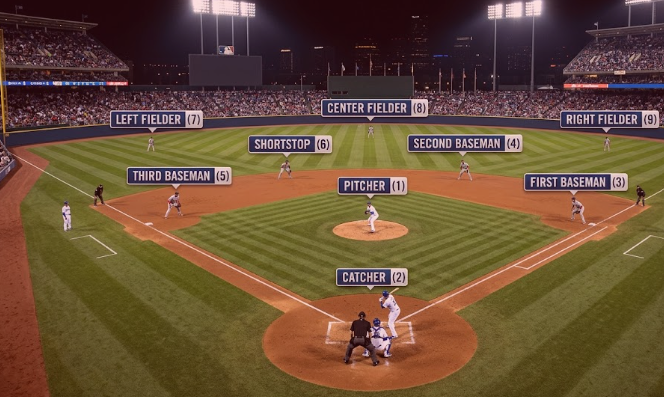
There are nine defensive positions in baseball:
- Pitcher (P)
- Catcher (C)
- First baseman (1B)
- Second baseman (2B)
- Third baseman (3B)
- Shortstop (SS)
- Left fielder (LF)
- Center fielder (CF)
- Right fielder (RF)
If the Designated Hitter (DH) rule is in effect, there is a tenth batting position where a hitter who does not play defense bats instead of the pitcher.
Infield Positions
The infield is made up of the players stationed near the four bases. Infielders play a significant part in the game’s defensive actions and require speed of reaction and accuracy in throwing.
Position: Pitcher (P)
Of all defensive players in the field, the pitcher is perhaps the most significant.
All plays start when the pitcher pitches the ball toward home plate with the aim of putting out the batter.
The duties of a pitcher include the following:
- Throwing strikes.
- Blocking hitters from getting to a base.
- Changing the type of pitch.
- Controlling the tempo of the game.
- Keeping runners at the bases.
There are several types of pitches that the pitchers use:
- Fastballs
- Curveballs
- Sliders
- Changeups
- Sinkers
Catcher (C)
The catcher stands right behind home plate and catches all the pitches thrown by the pitcher.
Most people regard the catcher as the on-field leader of the defense as he:
- Calls pitches.
- Communicates with pitchers.
- Blocks pitches thrown into the dirt.
- Throws out runners trying to steal bases.
- Positions players in the defense.
Catchers require good reflexes, toughness, leadership, and throwing ability.
As they catch all the pitches, catchers play an important part in the team’s defense.
First Baseman (1B)
The first baseman stands near the first base and participates in more plays than any other infielder.
He is responsible for:
- Catching balls thrown by other infielders.
- Making outs at first base.
- Fielding ground balls.
- Holding runners at first base.
- Starting double plays.
As a lot of throws are made from various angles, first basemen require soft hands, quick reflexes, and the ability to reach for the incoming throws.
Good defensive first basemen minimize fielding errors in the whole infield.
Second Baseman (2B)
This is the position that is located in the space between first and second bases.
Main duties involve:
- Fielding ground balls.
- Making double plays.
- Coving second base for steals.
- Receiving balls from the outfield.
- Providing back-up during defensive plays.
Second baseman players are known for their speed and agility.
They cooperate well with the shortstop in making double plays.
Third Baseman (3B)
Third basemen play in the area adjacent to the third base.
As most balls thrown by right-handed batters towards the third baseman are quite tough, the position got another name – the hot corner.
Third basemen have to:
- Have good reflexes.
- Handle well hit balls.
- Make long and precise throws to the first base.
- Defend bunted balls.
- Make double plays.
Third baseman need great throwing arm and fast reflexes.
Shortstop (SS)
Many baseball analysts regard the shortstop as the most athletic infield position.
Being positioned between second base and third base, the shortstop occupies a large amount of defensive space.
Duties involve:
- Filling ground balls.
- Forming double plays.
- Defending second base.
- Passing the ball.
- Organizing the infield defense.
Shortstops perform challenging tasks by throwing the ball across the field towards first base.
The ideal shortstop is characterized by speed, agility, strong arms, and good baseball sense.
Interested in learning how these defensive positions contribute during the postseason? Read our How the MLB Playoffs Work guide to see how every position plays a key role in the race to the World Series.
Understanding the Outfield Positions
Outfield is the large green field that extends past the infield. The outfielder must catch flies, prevent hits from going farther into the outfield, and throw the base runner out.
While all the outfield positions have the same duties, each position needs a different blend of skills.
Left Fielder (LF)
The left fielder is positioned on the left part of the outfield from the perspective of home plate.
His key responsibilities are:
- catch fly balls.
- field line drives.
- prevent doubles and triples.
- back up third base.
- return the ball fast to the infield.
Left fielders usually have to deal with strong right-handed batters who pull the ball into the left outfield and therefore need quick reflexes and proper positioning.
Center Fielder (CF)
The center fielder covers the largest area of the outfield.
According to many baseball professionals, this outfield position is one of the hardest due to the following reasons:
- To run fast after deep fly balls.
- cover gaps between outfielders.
- communicate with the left and right fielders.
- prevent extra-base hits.
- position the outfielders.
Typically, the center fielders are the fastest runners in their teams.
Right Fielder (RF)
A right fielder occupies the position that is on the other side of the outfield relative to the left fielder.
Duties include:
- Catching fly balls.
- Fielding line drives.
- Blocking advancement of runners.
- Backing up first base.
- Throwing long throws to third base and home plate.
Due to the long distance of the throws made from the right field, the right fielders normally have the strongest arm strength out of all outfielders.
What Is Designated Hitter (DH)?
In most cases, MLB games have Designated Hitters (DH).
Designated Hitters do not play defensive roles in the game but take the role of batters for pitchers.
The DH rule is now incorporated permanently into MLB and offers an opportunity for teams to:
- Use more powerful batters on their team.
- Protect their pitchers from getting injured.
- Have better offensive performance.
What Is a Utility Player?
A utility player is someone who can play several defensive roles.
Unlike specialists, a utility player is someone who can play any number of roles in the game.
They are capable of playing at:
- First base
- Second base
- Third base
- Shortstop
- Left field
- Center field
- Right field
Baseball Position Numbers Explained
In baseball scorekeeping, every defensive position is assigned a number.
These numbers help record plays quickly during games.
| Position | Abbreviation | Number |
|---|---|---|
| Pitcher | P | 1 |
| Catcher | C | 2 |
| First Baseman | 1B | 3 |
| Second Baseman | 2B | 4 |
| Third Baseman | 3B | 5 |
| Shortstop | SS | 6 |
| Left Fielder | LF | 7 |
| Center Fielder | CF | 8 |
| Right Fielder | RF | 9 |
For example, a 6-4-3 double play means the shortstop (6) throws to the second baseman (4), who then throws to the first baseman (3) to record two outs.
Understanding these numbers makes it much easier to follow baseball broadcasts, scorecards, and game analysis.
The Importance of Each Position
Each position on the baseball field helps a team win.
Pitchers and catchers dictate the play from the pitcher’s mound and home plate, while infielders work fast against ground balls to turn double plays. Outfielders guard against gaps, minimize extra-base hits, and make plays that will determine whether the team wins or loses the game.
Despite some positions being more highlighted than others, baseball is truly a team game. Communication and teamwork are very important.
Want to see how these positions become even more important during the postseason? Our How the MLB Playoffs Work guide explains how every defensive play can impact a team’s journey to the World Series.
FAQ
How many players are there on the field at once in baseball?
There are nine players defending their team’s territory at a time. For teams playing with the Designated Hitter rule, there is a tenth player batting in place of the pitcher.
What is the hardest position to play in baseball?
While some say that the pitcher has the hardest role due to his ability to control all the games and to be skilled, precise, and focused, others claim that the hardest position is shortstop as he has a wide area to defend and makes tough throws.
What is a catcher’s responsibility?
A catcher is responsible for receiving balls, calling the game, blocking wild throws, throwing out runners, and cooperating with the pitcher in managing the defense.
Why is shortstop an important position?
This position has a very wide field and participates in a lot of defensive plays such as ground balls, double plays, and throws in relays.
What is the Designated Hitter?
The Designated Hitter (DH) is a player who bats in place of the pitcher without playing a defensive position.
Conclusion
Learning about the MLB positions is one of the most important things that allow you to really enjoy the game. Every player in the field has their own role, and each of them needs a certain set of skills and cooperation.
Starting from the pitcher throwing the ball to start a game and going through the center fielder catching the ball and the catcher managing the whole defensive play – all these positions contribute to the team’s performance throughout the whole season.
Regardless whether you are watching your first MLB match or getting excited for the playoff games, learning the roles of each position will definitely increase your appreciation of the game.
Interested in learning about other popular American sports? Explore our Most Popular Sports in the USA guide to discover how baseball compares with football, basketball, hockey, and soccer.