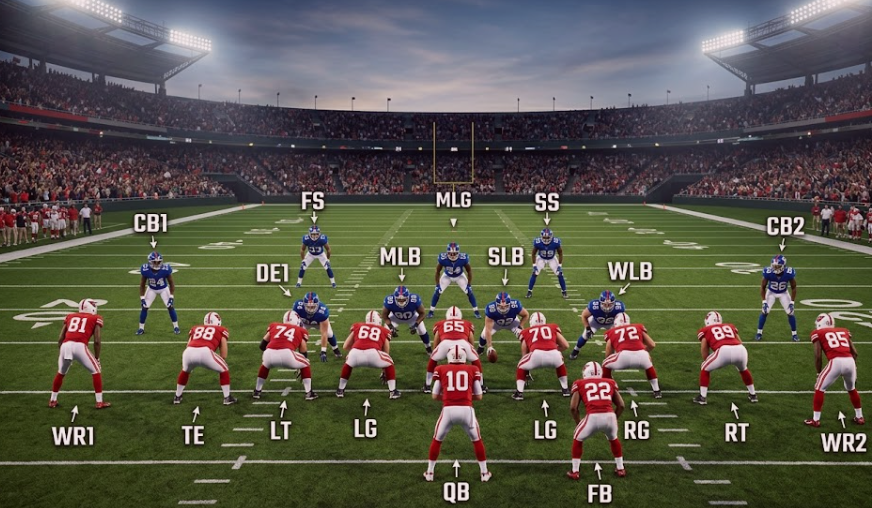

If you’re new to American football, trying to grasp NFL Positions Explained can feel overwhelming, like you’re reading a playbook that already forgot to show you the pages. With 22 players on the field at once, every athlete ends up with a specific role, and that role quietly adds to the team’s success.
Whether you’re watching your first NFL game, messing around with fantasy football, or just trying to understand the sport better, knowing what each position does will make the whole game way more enjoyable and less confusing.
In this complete guide, you’ll learn:
- How NFL positions are organized
- Every offensive position explained
- Every defensive position explained
- Special teams positions
- Which positions are the hardest
- Which positions score the most points
- Frequently asked questions
By the end of this guide, you’ll understand how each player helps win football games.
Table of Contents
- What Are NFL Positions?
- How NFL Teams Are Organized
- Offensive Positions Explained
- Defensive Positions Explained
- Special Teams Positions
- Which NFL Position Is the Hardest?
- Which Position Scores the Most Touchdowns?
- How All Positions Work Together
- Why Understanding NFL Positions Matters
- FAQs
- Final Thoughts
What Are NFL Positions?
In the NFL Positions Explained, each team really uses 11 players during almost every snap on the field. Those players are grouped into one of three units, kind of you could say, even if that sounds messy.
- Offense
- Defense
- Special Teams
Each unit comes with specialized roles for different responsibilities and tasks. Unlike a lot of other games, football makes every player handle a specific job; there is no free wandering. Outcomes depend on coordination, not only on individual skill or raw talent.
NFL Teams Are Organized
NFL teams work through three different groups, depending on what is happening in the game. It’s not always the same lineup; they swap units pretty often.
Offensive Unit
On offense, they try to:
- Score touchdowns
- Pick up first downs
- Maintain possession
- Push the ball downfield
The offense usually remains on the field until it scores, punts, or loses the ball; then it changes.
Defensive Unit
The defense aims to:
- Stop the offense
- Force turnovers
- Sack the quarterback
- Prevent touchdowns
Special Teams Unit
Special teams show up when:
- Kickoffs
- Punts
- Field goals
- Extra points
Even if they see fewer snaps, they can end up deciding the territory on the field and the momentum going forward.
Offensive Positions, explained a bit
The offense is tasked with scoring points, and yea it is the main thing in the end.
Quarterback (QB)
The quarterback is the head of the offense and gets his hands on the ball in almost every play, whether it is a quick snap or a longer dropback
Responsibilities
- Throw passes, ideally with timing
- Hand the football to the running backs
- Read defensive formations, like coverages and fronts
- Change plays before the snap if the defense shifts
- Lead offensive drives, from start to finish
Quarterbacks are frequently seen as the most crucial players in football, and people always talk about them.
Running Back (RB)
Running backs mostly carry the ball and make yardage happen when things tighten up.
Responsibilities
- Run between defenders
- Catch short passes
- Block blitzing defenders
- Score rushing touchdowns
A strong running back usually mixes speed, control, and field sight.
Fullback (FB)
Even if they show up less these days, fullbacks still matter in some offensive schemes.
Responsibilities
- Lead blocking, clearing lanes ahead
- Protect the quarterback in tricky moments
- Short-yardage rushing, when power matters
Wide Receiver (WR)
Wide receivers are the offense’s primary pass catchers, and, honestly, they do most of the catching work on most downs, even when the routes get messy.
Responsibilities
- Catch passes
- Create separation
- Gain yards after the catch
- Score touchdowns
Elite receivers have exceptional speed, agility, and hands that can be counted on, all the time though.
Tight End (TE)
Tight ends blend receiver skills with the grit of offensive linemen, and they do both jobs in the same play, a lot.
Responsibilities
- Catch passes
- Block defenders
- Support running plays
- Create mismatches against linebackers
Modern NFL offenses depend on versatile tight ends because they can shift role to role.
Offensive Line
The offensive line protects the quarterback, and it builds the running lanes that everyone wants to hit.
It is made up of:
- Left Tackle (LT)
- Left Guard (LG)
- Center (C)
- Right Guard (RG)
- Right Tackle (RT)
- Center (C)
Responsibilities:
- Snap the football
- Call blocking assignments
- Protect the middle
- Guards (LG & RG)
Responsibilities:
- Block defensive tackles
- Open rushing lanes
- Protect inside pressure
Tackles (LT & RT)
Responsibilities:
- Protect against edge rushers
- Defend the quarterback’s blind side
- Seal running lanes
The left tackle is often one of the highest-paid offensive players.
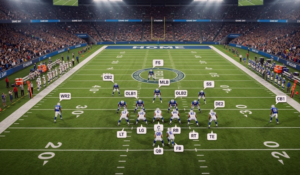
Defensive Positions, I mean, explained
The defense prevents the offense from scoring; that’s the main idea.
Defensive Line
Basically, the defensive line attacks the offensive line right after the snap; they are quick and up close.
Defensive Tackle (DT)
These guys do a lot. Responsibilities are usually like this:
- Stop inside runs, and keep them stuffed
- Pressure quarterbacks, no letting them breathe
- Occupy blockers, take them out of the play
- Collapse the pocket, pull everything inward
Defensive End (DE)
Responsibilities are pretty focused:
- Sack the quarterback
- Stop outside runs
- Force fumbles
- Pressure offensive tackles
Elite pass rushers, yes, they can completely turn a game around.
Linebackers
Linebackers play behind the defensive line and are among the most adaptable defenders. They read plays fast.
Middle Linebacker (MLB)
Responsibilities
- Call defensive signals
- Stop running plays
- Cover tight ends
- Blitz the quarterback
The middle linebacker is often called the “quarterback of the defense”, even though coaches say it that way.
Outside Linebacker (OLB)
Responsibilities
- Rush the passer
- Cover receivers
- Defend outside runs
- Blitz from the edge
- Defensive Backs
The secondary handles passing plays, they defend the throw, and the routes.
Cornerback (CB)
Responsibilities
- Cover wide receivers
- Defend pass plays
- Intercepts, throws?
- Tackle the receivers
Free Safety (FS) roles
Responsibilities
- Stop the deep routes
- Read the quarterback
- Help the cornerbacks
- Generate interceptions
Strong Safety (SS) duties
Responsibilities
- Shut down the running backs
- Match up with tight ends
- Blitz the quarterback
- Make open-field tackles
Special Teams Positions
Special teams take over those kicking moments a lot, not just one thing. It is more like the quick phase where points or NFL Positions can change.
Kicker (K)
Duties
- Field goals, mainly
- Extra points
- Kickoffs
Punter (P)
Duties
- Punt the football
- Improve field position
- Pin opponents deep
Long Snapper (LS)
Duties
- Accurate long snaps
- Support punts and field goals
Kick Returner (KR)
Duties
- Return kickoffs
- Gain field position
- Score return touchdowns
Punt Returner (PR)
Duties
- Catch punts
- Avoid defenders
- Return for positive yardage
Which NFL Position Is the Hardest?
Many analysts consider the quarterback the most difficult position because quarterbacks must:
- Learn complex playbooks
- Read defenses
- Make split-second decisions
- Throw accurately under pressure
- Lead teammates
Other demanding positions include:
- Left Tackle
- Cornerback
- Middle Linebacker
- Wide Receiver
Which Position Scores the Most Touchdowns?
Touchdowns are primarily scored by:
- Running Backs
- Wide Receivers
- Tight Ends
- Quarterbacks (rushing)
How All NFL Positions Work Together
Football is the ultimate team sport.
For example:
- Linemen protect quarterbacks.
- Quarterbacks deliver passes.
- Receivers catch the football.
- Running backs exploit blocking lanes.
Defensively:
- Defensive linemen pressure quarterbacks.
- Linebackers stop runners.
- Cornerbacks defend receivers.
- Safeties prevent big plays.
Special teams determine field position through punts, kickoffs, and field goals.
Championship teams succeed because every position performs its role effectively.
Why getting the NFL positions straight matters
When you can recognize what each role is really doing, you tend to understand the game more deeply. It helps you follow:
- coaching choices, not just the play itself
- player numbers and trends
- draft approaches and priorities
- game plans, how they fit together
- fantasy football too
And honestly, it makes every NFL game feel more exciting, because you start to see why the players are placed where they are, and what that placement is meant to accomplish.
Learn how young players enter the league in our NFL Draft Explained: How the NFL Draft Works and Why It Matters.
Discover how teams build championship rosters in NFL Salary Cap Explained: How It Works and Why It Matters.
See how teams qualify for the postseason in How NFL Playoffs Work: Complete Guide for Beginners.
Explore the biggest game in football in History of the Super Bowl: Champions, Records & Evolution.
Frequently Asked Questions
How many positions are there in the NFL?
An NFL team fields 11 players at a time across offense, defense, and special teams, with more than 20 specialized positions in total.
What is the most important position in football?
The quarterback is widely considered the most important because they lead the offense and make decisions on nearly every play.
Which NFL position is the fastest?
Wide receivers, cornerbacks, and kick returners are typically the fastest players on the field.
Which position is easiest for beginners to understand?
Quarterback, running back, and wide receiver are the easiest positions for new fans to recognize and follow.
Why are offensive linemen important?
Offensive linemen protect the quarterback, create running lanes, and give the offense time to execute plays.
Final Thoughts
Every NFL position has this unique purpose, and nobody really wins a game all by themselves. Like the quarterback, who is calling the offense into motion, and then the defensive backs staying ready for those long throws and the special teams group managing field position, every role matters, and it all stacks together.
When you actually know these positions, you start to see more of the game plan, the coordination, and the sheer athleticism that make the NFL such a thrilling sports league in the world. Whether you’re watching your first matchup or becoming a long-time supporter, learning what each position handles is one of the clearest ways to enjoy football more.