
Every NFL offseason brings this kind of buzz, surprises, and huge roster shifts. If you’re new to professional football, start with our complete guide on What Is the NFL? A Complete Beginner’s Guide to understand how the league operates before learning about free agency. Some star players go sign somewhere else, teams rebuild their lineups, and fans just wait, like ok… what is this going to do to the season coming up? This stuff mostly happens during NFL Free Agency Explained, which is one of the biggest moments on the football calendar.
But real talk, what is NFL free agency exactly? How does it work in practice? And why do certain players stay put with the same franchise while others end up taking those enormous contracts with a new organization?
In this beginner-friendly guide, you’ll get the full picture of NFL free agency. Like how a player becomes a free agent, what the different free agent types are, how the salary cap plays into all of it, and why free agency can totally reshape a team’s next few years.
What Is NFL Free Agency?
NFL Free Agency Explained is the window where players whose contracts are up can start talking to teams and then sign with a different club.
So instead of being locked into their old team, eligible players are allowed to look at offers across the league and decide what fits best for them, based on things like:
- Contract worth
- Guaranteed money
- How much they might play
- The coaching staff feels and scheme
- Chances to win a championship
- Team culture
- Where the team is located
Free agency lets teams upgrade their roster without trading and without waiting around for the NFL Draft.
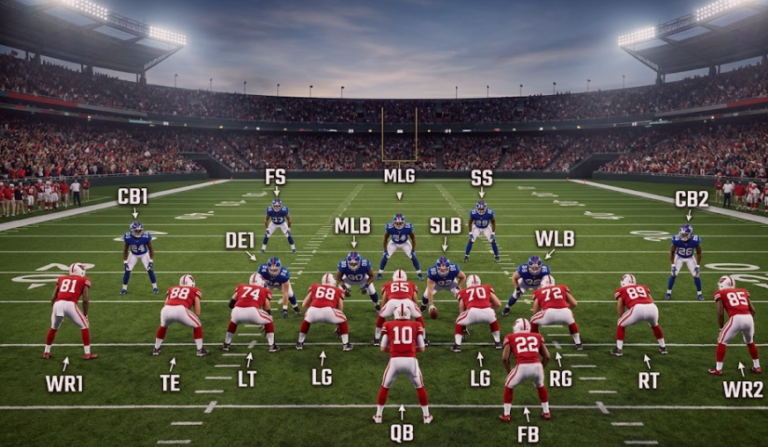
Every roster move also depends on each player’s role, so check out our guide on NFL Positions Explained: Every Position and What They Do to understand why teams target specific positions during free agency.
And honestly, some of the biggest player swings in NFL history happened right there in free agency.
Why does NFL Free Agency exist?
Honestly, it’s mainly about creating some kinda balance across the league. Like, without it, the best teams could just hold onto talented players forever, and then the weaker franchises would have a harder time improving, even if they’re trying. So the whole system helps in a few ways. Building a championship roster starts long before the playoffs, making smart free-agent signings an important part of every team’s long-term strategy. Learn more in our guide, How Teams Reach the Super Bowl.
- Players get paid something closer to fair market value
- Teams can address roster weaknesses
- Young rebuilding teams can become competitive faster
- Older veterans go after rings
- Fans get this exciting offseason vibe, too
Every March, free agency turns into this thing that’s almost as intense as the regular season, because a few blockbuster signings can really reshape the NFL landscape in a short time.
When does NFL Free Agency begin?
NFL free agency officially starts each year in March, right after the new league year begins.
Before that official opening, the NFL runs a period called the Legal Tampering Period
- During that window
- Teams can talk with agents
- Contract details get discussed in advance
- But nothing can actually become official yet
Then, once the new league year starts, players can sign contracts for real. That’s also why a lot of huge deals get announced almost immediately after free agency officially opens, kinda like clockwork.
Who becomes a free agent?
Not every player becomes a free agent every year, it’s not automatic
A player typically becomes a free agent when
- Their contract runs out
- Their team releases them
- They finish every contract obligation
After they’re eligible, they can sign with another franchise depending on their specific free-agent status, so it’s not the exact same process for everyone.
Types of NFL Free Agents
There are a few types of NFL free agents, and knowing what each one means is pretty important… because the rules are different and yeah it can get confusing.
1. Unrestricted Free Agent (UFA)
An Unrestricted Free Agent (UFA) is basically the most free-style option.
These guys can usually:
- Sign with any team they want.
- Discuss basically any contract terms they want.
- Walk away without asking for permission first.
Most of the time, players turn into unrestricted free agents after:
- They finish four or more accrued NFL seasons
- And they complete their contract
This is the category of free agency that tends to get the biggest headlines.
2. Restricted Free Agent (RFA)
Restricted free agents have a tighter lane, not as much wiggle room.
Their original team can send in a qualifying contract, often called a tender.
If another team shows interest and makes an offer, then the old team can:
- Match that offer
- Or decline to match and let the player go
- In some cases, there can also be draft pick compensation tied in
So the original team gets some leverage while the player can still sample the market, at least a bit.
3. Exclusive Rights Free Agent (ERFA)
An Exclusive Rights Free Agent has the least freedom of the bunch.
If their current team puts forward a minimum qualifying contract, then the player:
- Can’t really negotiate with other places.
- Has to either sign or sit out
This usually shows up with younger players, or guys with limited NFL time, not yet fully established in the league.
What even is the NFL salary cap?
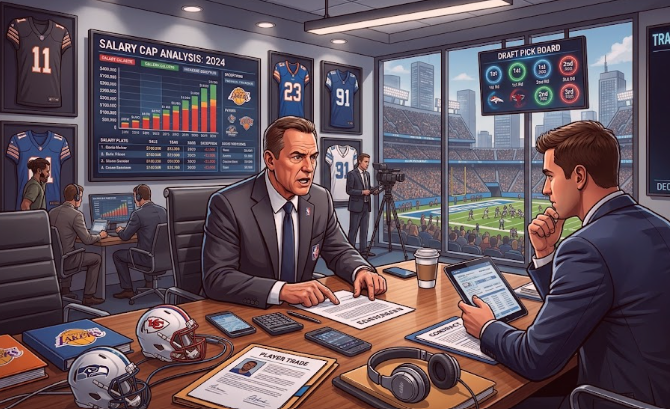
Honestly, one of the biggest moving pieces in free agency is the salary cap, like it or not.
This cap basically caps how much a team can put toward player salaries during the season.
And yeah, every single franchise is working under the same overall number, not some different deal for someone.
Strong roster management helps teams remain competitive throughout the season and increases their chances of making the postseason. Learn how the postseason works in our How NFL Playoffs Work: Complete Guide for Beginners.
So the whole point is kinda like this:
- It helps keep competitive parity
- it also blocks rich franchises from just swallowing every elite player
- and it pushes smarter roster stewardship instead of pure spending
But once the salary cap shows up, teams usually have to wrestle with tough calls, like which athlete they can realistically hold onto, and which one they have to let go, even if they “like” them.
How NFL teams build salary cap room
Teams generally use a mix of approaches to create cap space.
For example:
Releasing players
Sometimes, they part ways with older players because their contracts are getting a little too costly.
Restructuring contracts
Other times, they’ll shift compensation into signing bonus money, and then the cap impact gets spread across multiple seasons.
Trading players
If they move an expensive contract to another team, it can open up extra flexibility because the cap math changes.
Letting players walk
And sometimes, the simplest solution is just letting free agents depart if keeping them stops making financial sense.
Why huge contracts don’t always translate into huge salary cap hits
Fans hear about deals that are worth like $100 million or more, all the time.
But the salary cap kind of doesn’t work the same way.
A contract usually has multiple pieces, not just one big number, for example it can include:
- Signing bonuses
- base salary
- performance incentives
- roster bonuses
- guaranteed money
Then the cap hit gets worked out using a bunch of specific finance rules, rather than simply using the whole contract price.
That’s the reason teams can chase really expensive players and still stay under the salary cap.
So, what happens when free agency actually starts?
When free agency opens, teams jump into roster work pretty fast.
Most of the time, it looks something like this:
Step 1: Check what the team lacks
General managers figure out where things are weak. Understanding player positions makes it easier to see why teams prioritize certain signings during free agency. Read NFL Positions Explained: Every Position and What They Do for a complete breakdown.
Like maybe:
- Quarterback
- offensive line
- cornerback
- wide receiver
- pass rush
Step 2: Look over who’s available
Scouts and coaches study the free agents that are on the market.
They weigh stuff such as:
- Age
- production, and performance
- injury history
- leadership
- fit within the scheme
Step 3: Talk out the contract
Agents handle the back and forth on salary terms, bonus structures, guarantees, and how long the agreement is.
Step 4: Medical evaluations
Most signings require players to pass a physical exam, sometimes several checks.
Step 5: Official signing
After the paperwork is done, the player is officially part of the new team.
Why do some teams spend big anyway?
Not every franchise plays the free agency game the same way.
Some organizations go all-in for superstar talent.
Common reasons are:
- Going for a championship now
- covering for injured players
- plugging important gaps on the roster
- helping a young quarterback
- tightening up the positions that are falling behind
Other teams instead lean more on the NFL Draft and then take only reasonably priced veterans, instead of chasing big contracts.

Why does NFL free agency matter?
NFL free agency is not just some stretch of time for signing players; it’s also one of the biggest levers in sorting out whether a franchise can actually compete. A couple of good moves can take a decent club into a playoff conversation, while the wrong kind of decisions can kind of bury a team for a long while, and yeah, that happens more often than people think.
Each offseason, front offices go through film, rosters, cap numbers, and basically, they hunt for the spots that look thin. This is where free agency helps, because it gives teams a chance to patch those problems before the NFL Draft arrives and reshuffles everything.
For players, free agency is usually the first real runway to talk money. It’s where contract talks tend to catch up to what the market actually says they’re worth. A lot of athletes aim for long-range financial grounding, and some older guys might just want a situation that fits championship hopes in a more believable way, not merely hype.
For fans, the whole thing is fun and a little nerve-racking. You watch your squad bring in a star signal caller, a relentless pass rusher, or a top-tier wide receiver, and suddenly the expectations for the next season feel… different. Like, realistic different.
The Franchise Tag, in plain terms
Not everyone who hits the free market can freely walk out the door. NFL teams do have a useful tool, commonly called the Franchise Tag.
With a franchise tag, a team can hold onto one player for one more season, even if that player would otherwise become an unrestricted free agent.
That tagged player is given a one-year deal valued at either :
- the average salary of the top players at their position, or
- 120% of what they made before,
whichever comes out higher, because of course, the rules are not going to be simple like that.
There are also three main kinds of tags.
Exclusive Franchise Tag
The player is not allowed to negotiate with any other team.
Non‑Exclusive Franchise Tag
The player can talk with other teams, but the original team has the right to match the offer, or take draft pick compensation if the player walks.
Transition Tag
The player is free to negotiate elsewhere, while the original team can match the contract, but they do not receive any compensation if they don’t match.
In the end, the franchise tag gives teams more time to negotiate, and that can matter a lot when careers,
What are compensatory draft picks?
Ok, so sometimes losing certain free agents ends up helping a team… at least in the weird math way the NFL handles it. The league gives out “Compensatory Draft Picks” to teams that end up losing more, or just better, free agents than they actually bring in during the offseason.
Those extra selections usually land at the tail end of rounds three through seven in the NFL Draft. And the NFL does not just eyeball it, it looks at a few things, like player salary, how much playing time they got, and any postseason honors they picked up.
So basically, this whole setup pushes franchises to develop talent over time instead of always going all in on pricey free-agent signings.
Advantages of NFL free agency
Free agency can work out for both sides, players get choices, and teams can reshape rosters faster.
Teams Can Improve quickly
Instead of waiting around for rookies to grow, franchises can pull in experienced veterans right away. That can be huge when you’re trying to fix a hole fast or speed up a rebuild.
Players earn market value
Athletes also get a real shot at negotiating their contracts based on what they have actually shown, not just being stuck in older terms they signed before.
More Competitive League
Because teams can sign talent across the league, free agency helps keep the distribution of skill more spread out. It reduces the chance that a few organizations keep stacking dominance year after year.
Better Fan engagement
The offseason stays entertaining, too. Big signings create headlines, nonstop talk, and that renewed hope people love every spring.
Disadvantages of NFL free agency
Now, it is not all sunshine. Free agency comes with real downsides, and teams can get burned.
Expensive contracts
Sometimes teams pay a premium for a player after one standout season. It looks smart at first, then later it gets messy.
Salary cap challenges
Huge contracts can squeeze a roster hard. With the salary cap, money spent today can become a limitation tomorrow, making it harder to plug other needs later.
Injury concerns
A player can ink a massive deal and then run into injuries pretty soon after. That turns the investment into a tough situation for everyone.
Chemistry issues
Even if someone thrived on one team, that doesn’t guarantee the same results elsewhere. Differences in coaching, teammates, and even playing style can change how well a player fits and performs.
Free Agency vs. NFL Draft
Many new fans confuse free agency with the NFL Draft.
Here’s a simple comparison:
| NFL Free Agency | NFL Draft |
|---|---|
| Experienced NFL players | College football players |
| Players choose their team | Teams select players |
| Requires contract negotiations | Rookie contracts follow league rules |
| Immediate impact | Long-term development |
Both free agency and the NFL Draft help teams build competitive rosters capable of making deep postseason runs. Learn how those playoff journeys work in How NFL Playoffs Work: Complete Guide for Beginners.
Both systems are essential for building successful NFL teams.
Famous NFL Free Agency Signings
Over NFL history, free agency has created a bunch of moments that just stick, you know, even if people try to forget them.
Some of the most talked about moves include things like
- Tom Brady signed with the Tampa Bay Buccaneers before he guided them to a Super Bowl win.
- Peyton Manning joined the Denver Broncos after he left the Indianapolis Colts.
- Drew Brees signed with the New Orleans Saints and turned into one of the best signal callers in franchise history.
- Reggie White joined the Green Bay Packers during one of the earliest chapters of modern NFL free agency.
These signings show how a single player can flip a team’s trajectory, and sometimes it happens faster than people expect.
Common Misconceptions About NFL Free Agency
Every player becomes a free agent every year.
No. Only players whose contracts run out, or who are released, become free agents.
Players always choose the highest-paying team.
Not always. Quite a few players think about coaching fit, playing time, family needs, or the chance to chase a championship more than raw salary.
Teams can sign unlimited players.
Even if the league allows any number of signings, each agreement still has to sit inside the NFL salary cap, right, like it has to be boxed in.
In free agency, people often assume success is guaranteed.
No. A few of those highly anticipated additions end up underwhelming, often because of injuries, a mismatch in role, or a steady decline in performance.
Frequently Asked Questions
Can any NFL player become a free agent?
No. Only after a player’s contract runs out, or if the team cuts them, do they reach free agency.
When does NFL free agency begin?
Usually it kicks off in March, at the opening of the NFL’s new league year.
What is the difference between restricted and unrestricted free agents?
Restricted free agents can receive offers from other organizations, but their original team can match the offer. Unrestricted free agents are free to sign with whoever they choose.
What is the legal tampering period?
It is a brief bargaining window before free agency formally starts, giving teams and player agents a chance to talk about contract details.
Why is the salary cap important?
The salary cap sets a hard-ish limit on team spending, which helps keep things balanced across the league, so no one side runs too far ahead.
Conclusion
NFL free agency is one of the most exciting things happening every offseason. It lets players go after fresh chances while it gives teams the chance to sharpen their rosters before the next season even begins.
If you understand ideas like unrestricted and restricted free agency, the salary cap, franchise tags, and compensatory draft picks, then you can actually see the plan behind most major signings.
Whether your favorite team is chasing a championship or starting a rebuild, free agency plays a key role in steering the NFL season.
As you keep learning about pro football, you will notice a deeper respect for the behind-the-scenes business calls, long before kickoff on opening day. Want to continue learning about the NFL? Explore our beginner-friendly guides on What Is the NFL? A Complete Beginner’s Guide, NFL Positions Explained: Every Position and What They Do, How NFL Playoffs Work: Complete Guide for Beginners, and How Teams Reach the Super Bowl to deepen your understanding of America’s most popular sport.