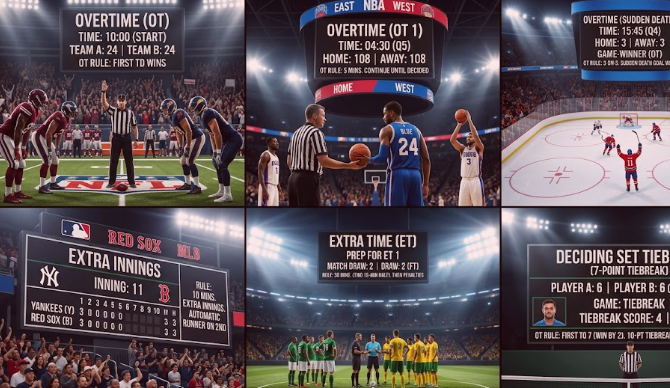

Overtime Rules Explained Different Sports is essential for understanding how different games determine a winner when regulation time ends in a tie. Rarely can anything compare to the thrill of a tied game in the closing stages. Rather than declaring a draw, many sports use overtime to decide the outcome. However, the overtime process is not the same in every sport. While some use additional overtime periods, others adopt a sudden-death format, and some rely on penalty shootouts or other tie-breaking methods to determine the winner.
This guide on Overtime Rules Explained Different Sports will assist you to learn the ways in which overtime takes place in various popular sports around the globe. This article will cover everything about overtime in such sports as football, basketball, hockey, baseball, soccer and tennis.
If you’re new to sports terminology, check out our Complete Guide to Sports Rules Explained before learning how overtime works.
What Is Overtime in Sports?
The extra time that takes place in case there is a tie in the final result after the set time is called overtime. This is needed to determine the winner when the usual time of play does not help.
Despite the fact that every sport uses its own version of overtime, the idea stays the same everywhere: to establish a tiebreak with equal conditions for all teams.
While some games have extra periods of the game, others have abbreviated periods or even sudden death, in which the first team that scores wins the match.
Why Do Sports Need Overtime?
Sports need overtime because there are competitions that always have winners.
Championship matches, playoffs, or knockout stages should never end in a tie, so sports create rules for such cases.
These include helping:
- Establish a clear winner of the game
- Make the game more interesting for spectators
- Make sure of the fair play of teams
- Continue the progress of tournaments
- Reward good performance of teams
Nevertheless, sometimes in the season games, the league can allow ties.
Understanding Regulation Time
In order to understand overtime, it is important to consider regulation time first.
Regulation time is the ordinary duration of the game before the start of any additional time periods.
These can be:
- NFL – four 15-minute quarters
- NBA – four 12-minute quarters
- NHL – three 20-minute periods
- Soccer – two 45-minute halves
- MLB – nine innings
- Tennis – a certain number of sets.
It becomes significant to discuss overtime only if teams are tied after regulation time.
NFL Overtime Regulations
There are some special provisions in the NFL regulations regarding overtime that are different from those of most other sports.
If a regular-season NFL game is tied at the end of four quarters, teams play one overtime period.
Some distinctive characteristics are:
- A toss of a coin helps to determine which team gets the ball first.
- Each team gets a chance to gain possession of the ball based on the outcome of the first possession.
- In case if teams are still tied at the end of overtime, the regular season game ends in a tie.
- Playoff games continue until there is a winner.
The NFL overtime regulations have developed over time.
Learn more about football gameplay in our Complete Guide to NFL Draft Explained.
Overtime Rules in NBA Games
Basketball has one of the simplest systems of playing overtime periods.
In case the score is even at the end of the regular NBA game:
- A five-minute overtime period is played.
- The team having a higher score at the end wins the game.
- In case of an even score, another overtime period starts.
The number of overtime periods is unlimited.
Sometimes, there have been more than one overtime periods in NBA games.
Overtime Rules in the NHL
In hockey, there are various rules that apply for the overtime based on whether the game is in the regular season or the playoff period.
Regular Season
The following are included in regular-season games in the NHL:
- 5 minutes of overtime
- Three against three hockey rather than five against five
- Sudden death—whichever side scores a goal wins
If there is no goal at all, then the teams go into a shootout phase.
Playoff
Playoff hockey is unique in its own way.
Teams keep on playing the overtime until they score a goal.
Since the game ends immediately after the scoring of a goal, the playoff overtime becomes a very exciting moment in hockey.
MLB Extra Innings Overview
Baseball does not have any concept of overtime.
Tied baseball games go into extra innings.
Each extra inning has the same format as a regular inning.
The game continues until there is a winner, which is when one team scores more than the other after both sides get their chance to bat.
In modern MLB, there is a starting runner on second base in regular season extra innings.
Understand scoring before learning extra innings in our Baseball Scoring Explained guide.
Soccer Extra Time Rules
Regular soccer games in the season would result in a tie if both sides have equal scores at the end of the game.
But in knockout tournaments, there must be a winner.
In such tournaments:
- Two extra periods of 15 minutes each would be played.
- The two teams change ends between periods.
- In case of tie, a penalty shootout is used to determine the winner.
Set Decisions and Tiebreaks in Tennis
Tennis deals with tied situations differently compared to other team sports.
In tennis, there is no overtime; play continues until one player has won the desired number of sets.
Tennis uses such techniques as:
- Tiebreak games
- Final set tiebreaks
- Match tiebreaks
Such approaches avoid an endless game but maintain fair competition.
College Sports Overtime Rules
College sports may have special overtime rules for college teams, different from those applied to the professional leagues.
Here are examples:
College Football
Teams alternate possessions from the designated place on the playing field until one of the teams scores more points in a certain round.
College Basketball
College basketball plays overtimes in the same manner as the NBA (National Basketball Association).
Why is there a difference in Over Time Rules for Different Sports?
Each sport has its own timing system, scoring pattern, and physicality, which makes it impossible to adopt the same overtime rules for all sports. The rules adopted for overtimes depend on the uniqueness of the games being played.
Factors that affect the overtime rules include:
- The physical nature of the game
- Frequency of scoring
- Safety of the players
- Television broadcast time
- Tournament requirement
- Experience of fans
In football, for instance, there are many collisions between the players; hence, overtime is relatively shorter so as not to increase the risk of injury. In basketball, where the frequency of scoring is higher, shorter overtime periods will not affect the integrity of the game.
Similarly, in baseball, since there is no time clock, extra innings come into play as opposed to traditional overtime periods.
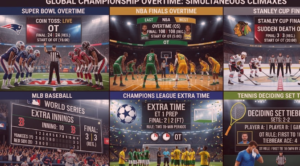
Sudden Death vs. Time-Oriented Overtime
One of the major distinctions among various sports is whether overtime utilizes sudden death or time orientation.
What Is Sudden Death?
In sudden death overtime, the match comes to an end once a goal is scored by either side.
Sports using sudden death are:
- Regular NHL season overtime
- Some situations in NFL overtime
- Some amateur/youth competitions
The strength of the sudden death format is that it builds up instant excitement since every shot can lead to victory.
But its drawback is that it may not always provide equal chances for both sides.
Timed Overtime Definition
Timed overtime is a system where both teams get the complete extra period for competition.
It is exemplified by:
- NBA overtime
- Collegiate basketball overtime
- Extra soccer time
In case the game is still tied at the end of overtime, some other process such as an additional overtime period or penalty shootout is used to decide on the winner.
Timed overtime is considered more balanced because both sides are provided with equal opportunities.
Learn more about game timing in our Complete Guide to Sports Clocks and Timekeeping.
Sports Overtime Marathon Matches
Some of the best things that have happened in the history of sports have taken place during some lengthy overtime matches.
Such examples are as follows:
- Overtime basketball playoff matches in the NBA
- Several periods of overtime play in the NHL
- MLB matches going way past the 9th inning
- Football matches in college with many overtime periods
- Tennis matches which last for several hours due to deciding sets
Benefits of Overtime Play
Overtime has several advantages for athletes, leagues, and fans.
Determining the Winner
Most tournaments need one team or athlete to be declared the winner. Overtime provides a fair way of declaring the winner.
Exciting the Fans
Nothing gets fans as excited about sport as a competitive overtime match that could be decided by one play.
Assessment of Mental Strength
Athletes will need to show mental strength by making tough decisions under tremendous pressure.
Generation of Special Memories
There have been some of the best championship wins and clutch plays made in overtime.
Problems and Criticism of Overtime
Even though it is exciting, overtime does come with some problems and criticism.
Some examples include:
Tired Players
More game time means more physical and mental tiredness, especially if you play a sport with a busy schedule.
Risk of Injury
Overtime plays make athletes more prone to injuries, especially when they play a sport that involves a lot of physical contact, such as football and hockey.
Problematic Scheduling
Overtime can be troublesome because of TV scheduling, stadium scheduling, and traveling.
Unfair Games
Some overtime games are considered unfair because they give one team an advantage. Thus, different sports associations change their policies about overtime from time to time.
Over Time Tactics Changes
The tactics used by coaches may vary if a match goes into overtime.
While not using the same tactics that were applied in the regulation time, they may apply:
- Sparing the energy of players
- Preserving possession
- Minimizing errors
- Making defensive changes
- Taking risks in situations where scoring chances present themselves
This is particularly crucial if there is the sudden-death rule.
Understanding Overtime for Fans
If you are a newbie in sports, understanding overtime is likely to be challenging since each league has its own rules regarding the issue.
Here are some helpful recommendations on how to understand overtime better:
- Find out how much regulation time is played in each sport.
- Learn about the format of overtime (timed, sudden death, or other).
- Remember to pay attention to what kind of game you are watching (regular season or playoffs) as the rules of overtime differ.
- Listen to announcements made by the league because there could be changes in the rules regarding overtime.
- Watch lots of close games to get used to how each sport deals with ties.
The more games you will watch, the faster you will learn the distinctive format of overtime in each sport.
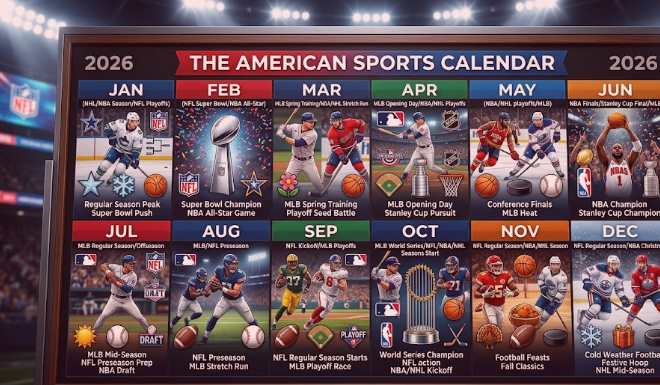
Explore our American Sports Seasons Explained guide to understand when playoffs and championship games—where overtime is most common—take place.
Overtime Misconceptions
There are various myths associated with overtime in different sports.
Myth #1: There is one set of overtime rules for all sports.
Each sport has a unique set of overtime rules depending on the nature of the game.
Myth #2: All tie games are followed by overtime period.
Many soccer games played during the regular season are allowed to end in a tie without going into an overtime period.
Myth #3: Overtime finishes fast.
There are many cases where overtime games have ended instantly, but there are some games that last for hours and even days before a winner emerges.
Myth #4: Overtime is applicable in professional games only.
Even youth leagues, collegiate games, and international games have overtime, although the rules are slightly different from those of professional leagues.
Frequently Asked Questions (FAQs)
What is overtime in sports?
Overtime is an extra session of play employed to establish the winner in case of a tie after the completion of regulation time.
Which sports include overtime?
The use of overtime or a variation of tie-breaking systems can be found in many sports such as NFL, NBA, NHL, soccer, college sports, and many others. In baseball, it is called extra innings, in tennis – deciding sets and tie breaks.
Are all overtime formats the same across sports?
No, all sports have their unique rules for overtime play in accordance with the type of sport, scores, safety issues, and competitive system.
What is sudden death overtime?
Sudden death overtime is the type of overtime in which the first team or individual to score immediately becomes the winner.
Why do some sports permit tie games?
It happens because some leagues tolerate tie results during the season to prevent very long games, while playoffs demand a winner.
Conclusion
Having an understanding of Overtime Rules in Different Sports will help fans to better understand the reason for varying ways of dealing with tied games. Be it NFL overtime, NBA extra period, NHL sudden-death hockey, MLB extra inning games, soccer extra time, or tennis tie-breakers, there is always a specific way through which different sports have found a way to settle ties.
Learning the differences in regulation game times, overtime rules, extra inning games, and penalty shoot-outs in different sports will help to understand the dynamics of each game a little bit better. Overtime is one of the most interesting elements of sports.