
The NBA playoffs are the most exciting time of the professional basketball calendar every year with millions of basketball fans around the world tuning in to watch the best players compete in an attempt to become champions. But if you’re a newcomer to the sport of basketball then all those terms such as “Play-In Tournament”, “playoff bracket”, “best-of-seven series” and “conference finals” may leave you confused about exactly how the NBA playoffs work.
Thankfully understanding the playoff format isn’t too tough. In this guide we’ll break down everything you need to know about how the NBA playoffs operate including how teams qualify, how seeding works and what it takes to make it to the NBA finals.
You’ll want to read our What Is the NBA? A Complete Beginner’s Guide if you’re getting started with basketball. This post will set up how the league is structured before we dive deeper into the postseason below.
If you’re new to basketball, our What Is the NBA? A Complete Beginner’s Guide explains the league structure, conferences, and regular season before you dive into the playoffs.
What Are the NBA Playoffs?
As you know by now, each year consists of an 82-game regular season. Once all games have been played, the NBA Playoffs — the postseason tournament — begin, where only the top-performing teams get the chance to go head-to-head for the championship.
The NBA Playoffs Work are a tournament format that aims to find the best team in the league, with each round consisting of head-to-head games between teams.
Since the outcome of each round matters more than usual (each game could decide the entire season), every game within the playoffs has huge significance for the teams playing.
In the end, the winner of the playoffs receives the prestigious Larry O’Brien Championship Trophy and gets official recognition as the NBA Champion.
How many teams make the NBA playoffs?
The NBA has 30 total teams split into two conferences:
- Eastern Conference
- Western Conference
Each conference has eight teams that make it into its respective “official” playoff bracket at this point — but because of the addition of the Play-In Tournament, there are now 10 teams in each conference that get an opportunity to play their way into one of the coveted eight spots on the playoffs bracket.
So nearly two-thirds of the entire league remains within reach all year long — and these final few weeks of the regular season should be as exciting for basketball fans as they’ve ever been!
Understanding the NBA Conferences
Before we dive into explaining the playoffs, you need to have an idea of how the NBA is structured.
Here’s what makes sense before talking about playoffs:
The league has been split down the middle between two conferences – with both having 15 teams.
Teams aim for the highest record they can get in their own respective conference during the regular season. This helps establish which team qualifies for the playoffs & its placement in that tournament.
As compared with other major international soccer leagues, which typically have promotion and relegation, advancement to the playoffs in Major League Soccer is purely based on regular season performance.
What Is the NBA Play-In Tournament?
One of the largest changes made recently to the NBA postseason has been the addition of the Play-In Tournament.
We’ll no longer be giving automatic bids to the top 8 teams in each conference — those ranked from 7th to 10th will instead compete for the last two playoff slots.
Here’s how it works:
- The #7 host #8.
- Whoever wins this game immediately locks up the #7 playoff seed.
- And whoever loses will get another shot at getting their team back into the playoffs.
Meanwhile:
- The 9th seed will host the 10th seed.
- The loser gets eliminated.
- And the winner moves on to play another game.
Finally:
- Loser (7) vs. Winner (8).
- The winner gets the 8th and final playoff spot,
- while the loser is eliminated from contention for a postseason berth.
Teams that do better in the regular season get rewarded with a more favorable bracket position, but they also give those lower on the standings another shot at reaching the playoffs.
How exactly does this process work?
Once you’ve figured out which teams qualify for the playoffs, those teams get a number between 1 and 8 to denote their placement in each conference. That’s where things start getting complicated.
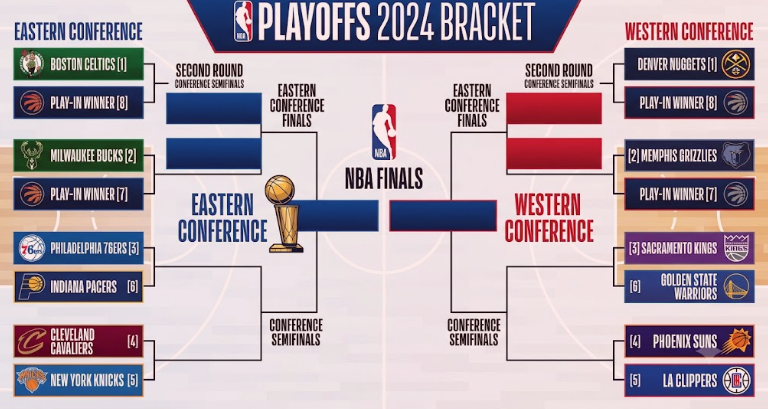
The team that had the best regular season gets the top spot as the No. 1 seed, followed by the No. 2 seed, and on down to the worst qualifying team, who earns the No. 8 slot. This ordering is known as “seeding.”
The first-round matchups are arranged like this:
- 1 vs. 8
- 2 vs. 7
- 3 vs. 6
- 4 vs. 5
Seeding rewards teams who did well during the regular season by matching them against lower seeds – or theoretically easier teams – when they enter the playoffs. Higher seeded teams are also granted home court advantages throughout the tournament, which can be an important edge if your team gets into a long playoff stretch.
How Does the NBA Playoff Bracket Work?
In comparison to other sports tournaments, which will have different matchups depending on how well each team performs, the bracket for the NBA Playoffs doesn’t change — you can see exactly who will face off against whom all the way through.
For example:
If the #8 seed beats the #1 seed they will advance on the other side of the bracket.
All conferences hold their own playoffs until there’s just one team left. Then those teams play each other for the championship in the NBA Finals.
How many rounds are there?
The NBA Playoffs consist of four rounds:
First Round
There are 8 teams to play out of each conference (top 8), for a total of 8 playoff series.
4 winners will be advanced from each conference.
Conference Semifinals
The remaining four teams will compete in order to get into the Conference Finals.
Only 2 of them will be able to make it
Conference Finals
The last 2 teams in each conference compete to see who will win that conference’s Championship (Eastern Conference Champion & Western Conference Champion)
NBA Finals
Our conference champions will go head-to-head to determine who takes home the crown — this prestigious series is watched by millions of fans around the world every year!
How does a best-of-seven series work?
All playoff matchups are conducted on a best-of-seven basis (two teams playing up to seven games).
A team must win 4 games in order to claim victory of their series and move forward into the next round.
Possible winning scores include:
- 4–0 (Sweep)
- 4–1
- 4–2
- 4–3
A “best-of-seven” format decreases the chances that luck will determine who takes home the crown and instead encourages consistency across all seven contests.
When you have to play your best for each and every contest, there’s plenty of room for coaches and players alike to make key adjustments from contest to contest. It’s why we love the playoffs — you never know what strategy may emerge.
If you’re curious how another major American sport determines its champion, check out our How NFL Playoffs Work guide to compare the two postseason formats.
Why Seeding Matters So Much
The benefits of regular season success extend far beyond just making the playoffs.
Higher-seeded teams usually receive:
- Easier first-round opponents.
- A potentially smoother ride through the bracket.
- Confidence boosted by great regular season showings.
Of course, there are plenty of upsets in the playoffs every year — but overall, historically, the higher-seeded team has been more likely to reach the NBA Finals.
So you can see why there’s tremendous incentive for the top seeds to be decided early on during what will already be a highly competitive regular season prior to the start of play in the postseason.
To better understand how championship-caliber teams are assembled under financial rules, read our NBA Salary Cap Explained guide. It explains how roster-building decisions can shape a team’s playoff chances throughout the season.
Home-Court Advantage in the NBA Playoffs
Perhaps one of the most rewarding aspects of securing a better seed? Home court advantage.
In fact, the team with the better regular season record will have more opportunities to host games as the series extends past five games. It’s common knowledge that an NBA squad generally performs at its peak when playing before its home crowd.
And now you know how your schedule looks out for all seven games of a best of seven series — which plays out in a 2-2-1-1-1 format:
- Game 1 – Higher seed hosts
- 2 – Higher seed hosts
- 3 – Lower seed hosts
- 4 – Lower seed hosts
- 5 – Higher seed hosts (if necessary)
- 6 – Lower seed hosts (if necessary)
- 7 – Higher seed hosts (if necessary)
This format provides an advantage to the team with the superior regular season performance as they will get the opportunity to host game 7 if required.
But this home court advantage does not always mean the team can win games, as there have been some amazing playoff upset victories from the underdogs who find success on the road.
What Is the NBA Finals?
The NBA Finals are the culmination (championship round) of the basketball league’s regular season.
After completing their own playoff brackets, the winners of each conference — East and West — compete against one another for the title.
As with every other playoff round, the NBA Finals are played under the same rules of a best-of-seven format. Whoever wins the first four games will become the NBA Champion, winning the right to take home the Larry O’Brien Championship Trophy.
One player will be recognized for their performance throughout this championship series as the NBA Finals MVP.
Winning the NBA Finals is seen as the highest achievement of professional basketball.

Can lower-seeded teams win the NBA championship? Yes (but rarely).
Higher-seeded teams usually have an edge as well since they had superior performances during the regular season while enjoying home court advantage over their counterparts.
Still, basketball history has seen some incredible upset wins by underdog teams – what we call “Cinderella stories”.
That’s why we all love watching the playoffs happen, with potential for wild cards to make deep runs and eliminate favorite titles. In fact, many times there will be teams who find themselves catching up on momentum at just the right moment, giving them enough chance to turn into contenders for real.
In general, every year’s playoff has unique excitement since nobody knows the result unless you win all four games in the finals.
What Happens if the Playoff Game is Tied?
Unlike other types of sports, NBA game can’t be tied.
The game goes into overtime if there is a tie at the end of the 4th quarter.
Overtime periods last for 5 minutes
If the game is still tied after playing the first overtime period, they will play an additional overtime period.
And it goes on till one of the teams finish an over time period with higher points than the other one.
There are some of the most unforgettable moments of the NBA history that happen during dramatic Overtime Playoff Games.
why you find the NBA playoffs to be exciting?
Many basketball fans consider that the playoffs are when the action reaches its pinnacle — unlike the regular season, where there are only 82 games to be played, each one in the postseason is imbued with tremendous significance.
Several factors make the postseason especially thrilling:
Each series is win-or-go-home, which adds extra stakes to games. Teams have opportunities to make strategic adjustments after each game. And many times, some of the top performers really elevate their play when the pressure is high, adding to rivalries between teams. There also are plenty of upsets that produce unforgettable moments. Championships and legacies are at stake too.
In short, we’re seeing an incredible level of competition because every team has one thing in common: winning the NBA championship.
NBA Playoffs vs. Regular Season
Although both are part of the same NBA season, the regular season and playoffs are very different.
| Regular Season | NBA Playoffs |
|---|---|
| 82 games per team | Best-of-seven series |
| Determines standings | Determines the champion |
| All 30 teams compete | Only 16 teams qualify |
| Teams can recover from losses | Four losses eliminate a team |
| Focus on consistency | Focus on surviving each series |
The regular season rewards consistency over several months, while the playoffs reward teams that perform their best under the highest pressure.
Frequently Asked Questions
How many teams make the playoffs?
Sixteen teams make the playoff bracket, with eight teams in the Eastern Conference and eight teams in the Western Conference. The teams seeded seventh through tenth have to play each other in the Play-In Tournament to determine the last two playoff spots.
How many games are in the NBA playoff series?
NBA playoff series are typically a best-of-seven format, with the first team that wins four games moving on to the next round.
Are regular season wins counted in the playoffs?
No, every team has a clean slate at the beginning of the playoffs. The only thing that will determine if a team will make it to the NBA Finals is its performance during the postseason.
Can an eight seed win the championship?
Yes, any team has a chance to win the NBA championship, which makes the playoffs so thrilling. An eight seed would have to win four best-of-seven games to lift the trophy.
When does the playoff happen?
How the NBA Playoffs Work always happen in the spring, starting in mid-April, once the regular season ends, and ending in June.
Final Words
NBA playoffs are when the games are played the hardest, and every point earned matters. The teams that make the NBA playoffs have demonstrated their skill and adaptability throughout the regular season. Any team that makes the playoffs has a chance to win the title if it wins four best-of-seven series. The NBA playoffs are essential to the sport, and knowing how they work allows you to be awed by the majesty of the NBA Finals no matter what team you support. The rounds get increasingly competitive, so there are moments in every championship series that will live in basketball history long after the final buzzer has sounded.
Interested in learning more about American sports? Explore our guide to the Most Popular Sports in the USA to see where basketball ranks and why it has such a massive global following.