

The difference between American football and rugby is one of the most common questions asked by sports fans worldwide. At first glance, both sports look kind of similar, because they use an oval ball, involve physical tackling, and teams try to score by carrying the ball into the opponent’s end zone or goal area.
But once you get into how the rules work, how the game flows, what equipment is used, the scoring system, and what players are actually responsible for, you’ll notice that American football and rugby are not just “close cousins”. They’re really different sports with separate origins, plus their own tactics.
Whether you’re new to sports or you’re just wondering how these matches compare, this guide covers everything you should know about the difference between American football and rugby.
What Is American Football?
American football is one of the most popular sports in the United States. It’s played between two teams of 11 players on a rectangular field, with goalposts at each end.
The goal is to move the football down the field and score touchdowns, while also stopping the other team from scoring the same way.
In professional American football, the NFL runs the competition. The league also hosts one of the world’s biggest annual sporting events, the Super Bowl.
If you’re new to the sport, start with our complete guide, “What Is the NFL? A Complete Beginner’s Guide,” to learn how America’s biggest football league operates.
What Is Rugby?
Rugby is one of the oldest and still most popular sports in the world. It started in England, and now it’s played professionally across Europe, Australia, New Zealand, South Africa, Argentina, Japan, plus a bunch of other places too.
Unlike American football , rugby keeps going in a more continuous way with few interruptions, so the game feels quick and, honestly, pretty brutal physically.
There are two main versions that most people talk about
- Rugby Union (15 players)
- Rugby League (13 players)
Most international tournaments choose Rugby Union rules, rather than the other one.
History of Both Sports
It’s sort of interesting that American football really did evolve from rugby in the late 19th century.
In the United States, universities slowly adjusted rugby by adding
- forward passing
- downs
- protective equipment
- specialized player roles
Step by step, American football became its own separate sport, and rugby kept growing internationally, like it didn’t stop at all.
American Football vs Rugby: Quick Comparison
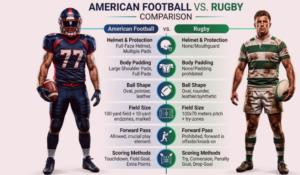
| Feature | American Football | Rugby |
|---|---|---|
| Players | 11 | 15 (Union) |
| Ball | Oval | Oval |
| Helmet | Yes | No |
| Shoulder Pads | Yes | No |
| Forward Pass | Allowed | Not allowed |
| Continuous Play | No | Yes |
| Tackling | Frequent stoppages | Play continues |
| Field Length | 100 yards | About 100 meters |
| Main League | NFL | Various international leagues |
Difference #1: how many people are out there
In American football, each team usually has 11 players on the field, and they’re split up, sort of, into offense, defense, and special teams units. It’s like each group has its own job, and you can swap roles, but not everyone is doing everything all the time.
In Rugby Union, teams have 15 players. Most of those players keep participating in both offense and defense for long stretches. So basically rugby players rely more on stamina and endurance, because they can’t just wait on the bench role-wise the same way.
Difference #2: the protective stuff
A really easy difference to spot is player equipment, like what covers them up while they run and collide.
- American football players typically wear: a helmet, a face mask, shoulder pads, hip pads, thigh pads, knee pads, and gloves.
- Rugby players usually wear: jersey, shorts, cleats, mouthguard, and an optional soft scrum cap.
Because rugby players don’t wear heavy protection, tackling techniques tend to focus on safer body positioning, angles, and control, more than “hitting through pads” or whatever.
Difference #3: passing rules
This one is probably the biggest rule shift, and it’s all about how the ball can be moved in the air.
In American football, players may throw the ball forward once per play from behind the line of scrimmage. Quarterbacks often try to send it far downfield, so long passes are pretty common.
In Rugby, forward passes are illegal. Players can only really do passes sideways and backward.
And if a team wants to keep moving toward the try line forward, they usually have to run or kick. They also keep possession while passing backward, but they can’t “advance” by tossing it forward. That ends up making the whole offensive style feel completely different.
To understand the specialized roles behind passing and receiving, read our guide, NFL Positions Explained: Every Position and What They Do.
Difference #4: Tackling
In American football, a tackle kinda ends things right away; basically, the play is over. Referees stop everything, and then the next play starts once the teams reset a bit, yeah.
In rugby, after a tackle, the action doesn’t just fully shut down. The game keeps moving. Players go back into it and fight for possession, like they’re scrapping for control. Teams also recycle the ball pretty quickly, so momentum doesn’t really die. That is why rugby feels more rapid and kind of continuous.
Difference #5: Game Flow
American football is built around short, explosive bursts. One play runs only for a couple of seconds then it stops again. Coaches often signal and call plays between downs, all the planning, right before the snap.
Rugby usually doesn’t interrupt as much. Players keep attacking and defending over and over, which demands serious stamina, not just a quick sprint.
Difference #6: Scoring System
American Football
- Touchdown – 6 points
- Extra Point – 1 point
- Two-Point Conversion – 2 points
- Field Goal – 3 points
- Safety – 2 points
Rugby Union
- Try – 5 points
- Conversion – 2 points
- Penalty Goal – 3 points
- Drop Goal – 3 points
Even though both sports involve grounding the ball near the opponent’s goal area, the way points are earned is not the same at all, so the whole rhythm of scoring changes a lot.
Difference #7, Field Dimensions
For American football, the field is about 100 yards in length and 53.3 yards across. It kind of feels narrower, even if it sounds simple on paper.
For rugby, the pitch is approximately 100 meters long, and it can be as wide as 70 meters. Usually, rugby grounds look wider, so there’s more room for expansive movement, like open spacing and quicker running angles.
So the main vibe is that rugby fields are generally wider, which supports more open play.
Difference #8, Game Duration
American football, the match is split into four quarters, with 15 minutes per quarter. If you just add it up, the total playing time is 60 minutes.
But actual broadcast time ends up over 3 hours, since there are timeouts, replay reviews, commercials, and all sorts of stoppages.
Rugby is different: it has two halves, 40 minutes each. In total, that’s 80 minutes on the clock.
And because play seldom pauses, rugby matches often end in under two hours, even if the scheduled halves sound longer at first.
Difference #9: Substitutions
In American football, teams can swap players in unlimited amounts right between plays. Like basically, after one play ends, they can do it again, no big limit. You see teams constantly rotating— offense, defense, and special teams, all the same time, depending on the situation.
Rugby, in contrast, puts a ceiling on substitutions. There are only so many changes allowed, and it feels more constrained. So most of the time, players stay on the pitch for the majority of the match.
Difference #10: Strategy
American football is kind of like chess, if you think about it. Each play is staged and planned ahead of time, well before the snap happens. Coaches also communicate a lot—signals, calls, the whole thing.
Rugby is way more fluid. Decisions happen while moving because play doesn’t really stop that often, so players must adapt in real time.
Difference #11: Player Positions
American football has these pretty specialized type positions, like, you know, Quarterback, Running Back, Wide Receiver, Tight End. Then on the other side, you’ve got Offensive Line, and also Linebacker, Cornerback, and Safety. Everyone fits into a very particular job, not just “whatever fits”, but a role that’s kind of defined for them.
Want to understand every offensive, defensive, and special teams role? Read our detailed guide, “NFL Positions Explained: Every Position and What They Do .”
Rugby positions are kind of divided into, basically, two groups:
- Forwards
- Prop
- Hooker
- Lock
- Flanker
- Number Eight
Backs
- Scrum-half
- Fly-half
- Centers
- Wings
- Fullback
And unlike American football, most rugby players end up taking part in both attack and defense so, not really like separate roles all the time.
Difference #12: Popularity Around the World
American football kind of dominates in the United States and also in Canada, with small rule variations. You can see it there, more than everywhere else, kinda.
Rugby is hugely popular in England, New Zealand, Australia, South Africa, France, Ireland, Wales, Scotland, plus Argentina and Japan
So overall, rugby has a wider international footprint, while American football stays strongest in North America.
Which sport is more physical, really?
Both sports are wildly physical, just like… in different kinds of ways, and people notice that fast.
American football kinda leans into
- Explosive collisions
- Big, hard-impact tackles
- Short, intense bursts of action
Rugby instead leans into
- More constant physical contact
- Endurance, like straight-up staying power
- Repeated tackling, mostly without long pauses
Also, since rugby players wear very little protection, good tackling technique is non-negotiable; it matters a lot, way more than you’d expect.
Which sport is harder to learn?
For beginners, American football can feel more confusing due to
- Downs
- Penalties
- Formations
- Playbooks
- Specialized roles, or positions
Rugby has fewer stoppages, but you still need to get your head around the continuous flow, plus rucks, mauls, scrums, and offside rules that keep showing up.
So yeah, both take time to truly master, but once you know the basic rhythm, each one turns into this genuinely rewarding kind of viewing.
Frequently Asked Questions
Is rugby the same as American football?
No. Even though American football kinda grew out of rugby, they are separate sports, with different rules, gear, scoring methods, and day-to-day gameplay.
Which sport came first?
Rugby was invented first. American football mostly developed from rugby during the late 1800s, so yeah, there’s a timeline there.
Why do rugby players not wear helmets?
Rugby leans hard on safe contact mechanics and nonstop action, so the need for bulky protective equipment is less compared to American football.
Which sport is more popular?
American football is more popular in the United States, while rugby has a wider global reach across Europe, Oceania, Africa, and parts of Asia.
Can rugby players play American football?
A lot of rugby athletes have switched over to American football and done well. Mostly because of tackling skill, quick acceleration, and overall athleticism, but they still have to study new rules, plus specialized roles.
Final Thoughts
Getting the difference between American football and rugby feels way easier once you line up their rules, equipment, scoring systems, and the overall vibe of play. Even if they share a family resemblance, they’ve still turned into distinct games, with their own strategies and little traditions that matter.
American football tends to center on planned, structured plays, specialist positions, and tactical coaching. Rugby, on the other hand, is more continuous action, long breathing efforts, and collective teamwork. So whether you like the sudden, high-energy excitement of the NFL or the fast-moving flow of rugby, both bring intense competition and loyal supporters, all around the world.