
In this guide, you’ll learn how the FIFA World Cup works, including how national teams qualify, how the group stage and knockout rounds are organized, what happens when matches end in a draw, and how one nation ultimately becomes the FIFA World Cup champion.
Fortunately, the tournament follows a predictable format you’ll be able to grasp quickly.
This article covers how the FIFA World Cup works. You’ll learn about qualification and the various stages teams advance through from the group stage to the final championship match that will be played in stadiums all over the world.
If you’re new to the sport, start by reading our Soccer Rules for Beginners guide to understand the basic rules before exploring how the FIFA World Cup tournament is played.
What is the FIFA World Cup?
The FIFA World Cup is the top international soccer competition governed by FIFA (Fdration Internationale de Football Association). In contrast to professional leagues in which professional clubs play through an entire season, the World Cup features countries competing rather than clubs.
In the World Cup, players are associated with their respective national teams rather than professional teams, making it an exceptionally special occasion of international play.
The event is contested every four years, and it is regarded as the sport’s ultimate championship event in the world of soccer.
When is the FIFA World Cup the 4-year event held?
The FIFA World Cup is held every four years. This rhythm ensures that nations can compete in qualification tournaments and that athletes are able to play in their respective leagues and respective continents on a periodic basis.
Additionally, the fact that the World Cup takes place only every four years contributes to the overall sense of thrill and occasion, as each competition attracts billions of global viewers.
How Many FIFA World Cup Teams?
Over time, the World Cup has hosted a range of formats. As of the 2022 FIFA World Cup, there were 32 countries in the tournament.
For example, The next FIFA World Cup, starting in 2026, is scheduled to have 48 countries in attendance. This larger tournament is expected to foster increased international engagement and enhance the entertainment value of match play, giving more countries a chance to play on the world stage.
What Countries Play In The FIFA World Cup?
As with club games, nations are not automatically guaranteed a place at the World Cup and must qualify instead.
Countries must fight it out to be one of the nation representatives to be in the FIFA-arranged qualifying rounds managed by FIFA’s 6 confederations. These are the groups: AFC (Asia) CAF (Africa) CONCACAF (North & Central America and the Caribbean) CONMEBOL (South America) OFC (Oceania) UEFA (Europe) Each of these confederations has a determined amount of qualification places by FIFA.
The respective nations compete with others in the same region over a couple of months, or even years, in order to qualify for the tournament.
How FIFA World Cup Qualification Works
Regardless of whether the confederation has its own qualifying, it has one goal: to provide their representatives that will play in the tournament. This could consist of a:
- Round robin league groups
- Home-away game system
- Knockout playoffs
- Intercontinental playoff matches
Strong showing in this round guarantees a place, and only good teams do make it. Just qualifying for the World Cup is considered success for most.
How Does the FIFA World Cup Group Stage Work?
Once all 32 qualifiers make it to the tournament, play will get underway with the group stages. In the World Cup group stage, all participating nations will go toe to toe with each other to cut out all but two from each pool. In the 32-team competition: the 32 teams will be split into 8 different pools each containing 4 different teams where everyone gets to face off against one another once in a full round robin format.
That makes sure everyone gets to compete at least three times in the FIFA tournament.
Teams are awarded with the following number of points depending on how they do:
- 3 for winning a match
- 1 for drawing a match
- 0 for losing a match.
From each pool, only two teams will be able to qualify through to the knockout stage.
To learn how professional club competitions operate throughout the season, read our How Soccer Leagues Work Around the World guide.
How to rank team groups?
When multiple teams finish on level terms with the exact same number of points, ties are broken by means of following criteria: goal difference goals scored head-to-head between competing teams fair play record drawing of lots if none of the previous applies So, if a team had the better goal difference, it may lead to qualification, and because teams keep trying to score when they already lead to give them the better goal difference, this usually results in very close and exciting group stage matches.
What is the knockout stage?
Once the initial group stage is over, it’s into the spectacular knockout stage. It means there’s no room for error, with each game a one-off knockout tie: lose, and you’re out. This raises the stakes considerably, and many of the greatest World Cup memories come from this part of the competition.
FIFA World Cup Knockout Stage Understanding the Bracket
There’s a predetermined shape for the knockout bracket. Winners of groups play against runners-up of other groups, so teams that were in the same group aren’t matched up against each other right away. Through these several rounds, the bracket leads you to the following: round of 16, quarterfinals, semifinals, third-place playoff, and, finally, the final match. Each step the winner takes through the bracket gets closer and closer to their goal of world cup supremacy.
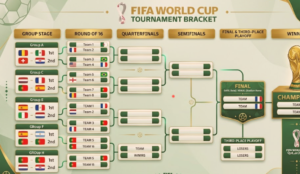
Why the Group Stage Is So Important
The Reason Why the Group Stage is So Essential Although each and every team is aspiring to walk away with the cup, that victory frequently relies on an solid foundation put down in the group stage. Topping your group places the team in a favorable position as far as progressing through the knockout tournament is concerned. A tactical and offensive balance between the two sides can typically be observed because just about every point really does count. Some of the most shocking results ever witnessed in World Cup matches happen throughout the group stage, where lesser known sides could quite possibly have already knocked-out traditional powerhouses of the sport.
If you’d like to understand how international tournaments differ from club competitions, read our How Soccer Leagues Work Around the World guide to learn how domestic leagues operate throughout the year.
Round of 16
The knockout rounds kick off with the Round of 16, where the 16 qualified teams from the group stage go head to head for a spot in the quarter-finals. This is an all or nothing scenario, where the winners move on to the next stage of the tournament and the loser is sent packing. In general, the winner of one group will face off against a runner-up in another group, rewarding those at the top of their group by pairing them against a less challenging opponent (in theory).
The win-or-go-home nature of the round often leads to shocking upsets and stunning goals!
Quarterfinals
Quarter-finals With only 8 teams left, the quarter-finals is the stage where things really heat up! Now, every team is just 2 wins away from making the World Cup Final, and tactics, defensive stability, and moments of genius are crucial. Incredibly exciting matches and many of the greatest goals have been scored at this stage of the tournament with some of the best players on earth coming to the party!
Semifinals
The winners of the four quarter-final ties move to the semifinals. Any team that wins their semifinal is guaranteed a spot in the World Cup Final. Any losing team is afforded one last chance at a bronze medal when they meet in the third place playoff. It goes without saying, semifinal clashes have become some of the most viewed contests globally as fans will flock to cheer on their nation as they aim to become football champions of the world.
What Is the third place playoff?
The FIFA World Cup is unusual in that it has a third place playoff. The two losers of the semi finals play each other one more time to try and sort out which team comes third. While it may not give the team the glory of becoming World Cup Champions, taking third is still a commendable goal and it means the team can walk away from the tournament with a win.
What If A Knockout Game Ends In a Draw?
In the knockout stage of an event, draws are simply not permitted, unlike the group stages. If a knockout match remains a tie after the full ninety minutes, the contest proceeds to extra time.
Extra time comprises:
- two fifteen-minute periods
- with a brief pause in between half-time.
If the scores are still level following the end of extra-time, then the match is decided with a penalty shootout.
Within a penalty shoot-out:
- each side will take 5 kicks
- should scores still be tied following those, then the game will proceed, one kick at a time in a sudden death fashion until a victor is found.
Some of the most dramatic and emotional moments in football history have occurred during World Cup penalty shootouts.
What Makes the FIFA World Cup So Popular?
The FIFA World Cup isn’t just a soccer tournament, it’s a celebration of sport and culture across the entire planet. Here’s why this quadrennial event is the greatest sporting competition: National pride brings devoted fans to every country in the world. The tournament only happens every four years.
It showcases the planet’s finest football talent playing for their nation.
- Historic underdog upsets.
- Each knockout stage game brings with it intense pressure.
- The tournament attracts a billion viewers worldwide.
It’s a way that people from around the globe, and many cultures, bond together in passion.
FIFA World Cup vs. Club Football
Many new fans wonder how the FIFA World Cup differs from club competitions.
| FIFA World Cup | Club Football |
|---|---|
| National teams compete | Professional clubs compete |
| Held every four years | Played every season |
| Qualification through continental competitions | Qualification based on league performance |
| Single tournament | Full league season plus cup competitions |
| World champion is a country | Champion is a football club |
Understanding this distinction helps fans appreciate why the World Cup is considered so unique.
Interested in Europe’s biggest club tournament? Check out our UEFA Champions League Explained article to understand how it differs from the FIFA World Cup.
FAQs
How many years between FIFA World Cup tournaments?
The FIFA World Cup takes place once every four years.
How many teams take part in the FIFA World Cup?
The FIFA World Cup took place with 32 teams in 2022 but from the FIFA World Cup in 2026 there will be 48 participating teams.
How many group games do teams play in the World Cup?
Each team play three group games, once against each of the others in the same group.
Can a World Cup knock-out match be a draw?
No If the two teams draw after 90 minutes the games will go to extra time and if still tied at that point penalty kicks would decide the victor.
What do the winners receive?
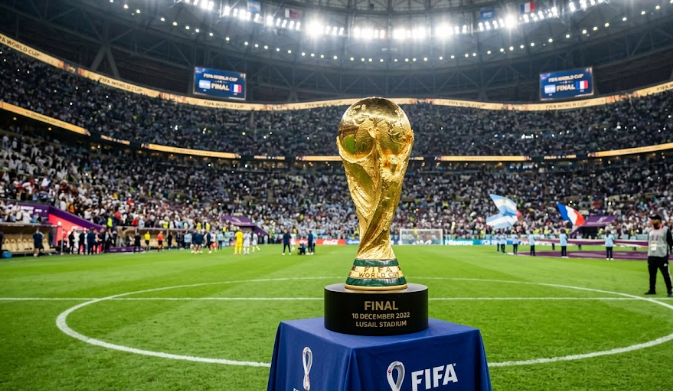
The winning team takes home the FIFA World Cup trophy, one of the most famous trophies in world sport.
Conclusion
The FIFA World Cup is the zenith of global football, pitting the greatest national teams from all around the world against one another in the race for the game’s ultimate reward. Between the gruelling qualification stage, a dynamic group stage, and intense knockout fixtures, each phase of the competition adds a special layer to the allure of the World Cup.
If you can understand the various components of this event, you’ll find yourself better able to appreciate the strategical rivalries, profound sentiments and storied history associated with each iteration of the event. Regardless of whether this is your first World Cup experience, or you have spent years following football, getting a grip of the FIFA World Cup system will serve to significantly enhance your experience.
Want to explore more global sporting events? Our Olympic Sports Explained guide covers another international competition that brings athletes from around the world together.