
The FIFA World Cup Explained is the biggest and honestly, most prestigious international soccer tournament in the world. Every four years, the top national teams show up to compete for the chance to lift one of the most famous trophies in all of sports. Millions of fans travel across the globe to watch matches in person, while billions more follow the whole event on television, streaming online, and everywhere in between.
If you’re new to soccer, understanding the FIFA World Cup can feel a bit confusing at first. Questions like Who qualifies? How does the tournament work? Why is it only held every four years? These are common among beginners.
In this all-in guide, you’ll learn everything you need to know about the FIFA World Cup, including its history, how qualification works, the tournament format, unforgettable moments, legendary players, and why it keeps being the world’s most celebrated sporting event.
What is the FIFA World Cup?
The FIFA World Cup is an international men’s soccer competition run by the Fédération Internationale de Football Association (FIFA), which acts as the authority for world soccer.
In contrast to club competitions, the World Cup uses national teams, so players represent their countries rather than professional clubs.
The tournament ends by naming the best national soccer team worldwide.
Nowadays, the World Cup is often viewed as one of the most impressive sporting spectacles besides the Olympic Games.
A little history of the FIFA World Cup
The first FIFA World Cup happened in 1930 in Uruguay.
In the opening tournament, only 13 nations took part, and Uruguay became the first champion, after beating Argentina in the final.
After that, the whole competition kept expanding in many ways and became more global.
Some notable moments include:
- 1930 – the First FIFA World Cup
- 1950 – Brazil hosted the event following World War II
- 1970 – Brazil won its third title, and it was allowed to keep the Jules Rimet Trophy for good
- 1998, Expanded to 32 teams
- In 2022, Argentina won one of the most dramatic finals ever; it was intense for everyone. In In
- 2026, the tournament expands to 48 teams, and people already act like it is a brand new era
Today, the World Cup pulls in followers from basically every country on Earth.
Why do they call it the FIFA World Cup?
FIFA stands for
Fédération Internationale de Football Association
It was founded in 1904, and it runs international soccer tournaments, and it also handles a bunch of systems like
- international events
- global standings
- refereeing rules
- youth events
- women’s events
- and the whole World Cup organisation
Since FIFA is the one running the event it gets called the FIFA World Cup, officially.
How often is the FIFA World Cup held?
The FIFA World Cup happens every four years
That timing gives national teams enough room to
- Grow young players
- play qualification matches
- Get ready for the international stage
- And honestly, the four-year pause makes it feel more unique, and people anticipate it a lot.
How do teams qualify for the FIFA World Cup?
Not every country just jumps in automatically
National teams have to take part in qualification tournaments that are organised by their continental confederations
You will see confederations like these
- UEFA in Europe
- CONMEBOL in South America
- CONCACAF in North America
- CAF in Africa
- AFC in Asia
- OFC (Oceania)
Each confederation gets several spots for the World Cup, based on FIFA’s allocation.
Teams have played host-and-away matches for several years. They gather points along the way to lock in qualification.
If you’re new to international soccer, our guide on How Soccer Leagues Work Around the World explains how domestic leagues and international competitions are connected.
How many teams play in the World Cup?
Up to 2022, the tournament had 32 teams in total, and it felt pretty standard.
But starting with the 2026 FIFA World Cup, that number goes up to 48 squads, so more countries can take part
That means a few things, like wider global representation. More thrilling matches, too, and also better chances for emerging soccer nations to show up. Even more supporters end up backing their own countries.
FIFA World Cup Tournament Format
The whole competition is split into two big phases, kind of like you can think of it as, first groups then elimination.
Group Stage
Teams are placed into groups.
Each team plays a set of matches against the other teams in the same group.
Points are counted like this:
- Win gives 3 points
- Draw gives 1 point
- Loss gives 0 points
Then the stronger teams, based on points, move forward.
Knockout Stage
After that comes the knockout stage, which includes:
- Round of 16
- Quarterfinals
- Semifinals
- Third-place playoff
- Final
Here, the rule is simpler; once a team loses, it is out.
But if a match ends tied, they use Extra Time first, then a Penalty Shootout to determine the winner
To understand how knockout tournaments work in another major sport, read our guide on How NFL Playoffs Work: Complete Guide for Beginners.
How long does the tournament last?
The FIFA World Cup usually goes on for about one month, give or take.
During this stretch, things go step by step
Group matches show up first, then the knockout rounds follow, yes. Later, the whole event wraps up with the World Cup Final.
So overall, fans get to watch dozens of games across four lively weeks.
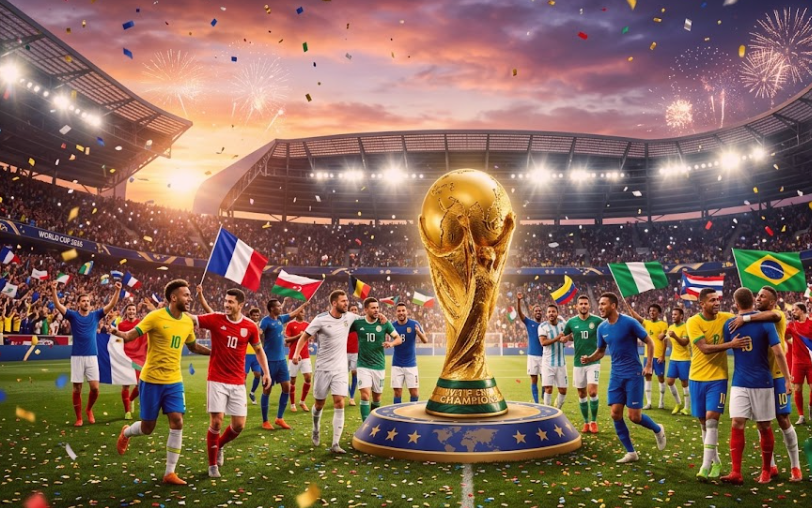
What is the FIFA World Cup trophy?
The FIFA World Cup Trophy is one of the most recognisable trophies in sports, period.
It includes
- Two human figures, holding the Earth
- It is made mostly from 18-carat gold
- And it stands roughly 36.5 cm tall
Lifting this trophy counts as the top milestone in international soccer.
Which Countries Have Won the Most World Cups?
Historically, several nations have dominated the tournament.
The most successful countries include:
| Country | Titles |
|---|---|
| Brazil | 5 |
| Germany | 4 |
| Italy | 4 |
| Argentina | 3 |
| France | 2 |
| Uruguay | 2 |
| England | 1 |
| Spain | 1 |
Brazil remains the most successful nation in FIFA World Cup history.
Greatest FIFA World Cup Players
So many legendary players ended up as global icons, because of the World Cup, honestly. It was one of those big stages where everything mattered, and you could see it.
Some of the greatest names you will hear are:
- Pelé
- Diego Maradona
- Lionel Messi
- Cristiano Ronaldo
- Zinedine Zidane
- Ronaldo Nazário
- Kylian Mbappé
These guys delivered memorable performances right on soccer’s biggest stage.
If you’re just getting into soccer, our Soccer Positions Explained guide will help you understand the roles these legendary players performed on the field.
Why the FIFA World Cup is so popular
There are a few factors that make the FIFA World Cup Explained really unique, and not just in a simple way. It feels different every time, even when you watch it before
National pride
Players represent their nations, not the professional clubs they usually train for.
So when someone wins, it turns into a big national celebration, with real feeling, not just headlines.
Global audience
More than 200 countries take part in the qualification process.
Then, billions of viewers end up watching across the globe.
Unpredictable results
Smaller countries sometimes defeat the usual “top” teams and powerhouses.
Those unexpected shocks end up creating moments people remember for years
Legendary performances
Each tournament brings forward new stars, while also letting the more established players strengthen their legacies.
Cultural celebration
The World Cup brings together fans with different cultures, languages, and backgrounds, but they still connect through a shared devotion to soccer
Memorable FIFA World Cup moments
The event has generated countless scenes that people keep talking about.
Some of the greatest ones include:
- Uruguay won the inaugural tournament (1930).
- Pelé became the youngest World Cup champion
- Diego Maradona scored that wild solo goal versus England, and it still feels unreal, even now.
- Then there is France, which won at home in 1998, right on their own ground, you know.
- Also, Spain, not long after, took their first title back in 2010.
- And Germany putting on a ruthless show against Brazil in 2014, that 7–1 scoreline stays in people’s minds.
- Argentina, meanwhile, sealed the dramatic 2022 final after it went to a penalty shootout, and the crowd went quiet, then exploded again.
Moments like these keep lighting up new soccer fans, generation after generation.
FIFA World Cup vs UEFA Champions League
Many beginners confuse these competitions.
Here’s the difference:
| FIFA World Cup | UEFA Champions League |
|---|---|
| National teams | Professional clubs |
| Every four years | Every year |
| Organised by FIFA | Organised by UEFA |
| Represents countries | Represents clubs |
| World’s biggest international tournament | Europe’s biggest club competition |
Want to learn more about Europe’s top club competition? Read our complete guide to the UEFA Champions League Explained.
Interesting FIFA World Cup Facts
- The first tournament was in 1930; it is notable.
- It is organised every four years, roughly.
- Over 200 nations enter the qualification stages.
- Brazil has won the most titles overall.
- The tournament is watched by billions worldwide, every edition.
- For 2026, there will be 48 teams in the competition.
- Each World Cup introduces future soccer legends to the audience.
Frequently Asked Questions
Who’s the one who organises the FIFA World Cup?
FIFA does, plain and simple.
How often does the World Cup happen?
Every four years, without much surprise.
Which country has won the most FIFA World Cups?
Brazil has the most trophies, with five titles.
Can any country try to qualify?
Every FIFA member nation can attempt to qualify, using regional competitions.
Why is the World Cup so famous anyway?
Because it brings together top-level play, national pride, loud supporters, and those moments you remember later, it becomes the biggest occasion in international soccer.
Final Thoughts
The FIFA World Cup feels like more than a soccer tournament. It’s a global celebration of sport, culture, and national pride, and every four years, people from everywhere gather to see memorable matches, legendary shows, and historic times that really shape the sport’s legacy.
Whether you’re watching your first World Cup or trying to deepen your understanding of the tournament, knowing a bit about its past, how teams qualify, the overall format and why it matters will make every match feel even more engaging. Even as the competition keeps expanding, and it continues to grow in momentum, the FIFA World Cup still stands as the highest point in international soccer, and also one of the most eagerly awaited sporting moments on the planet.