
Getting a grasp on soccer rules for beginners is a first step to actually enjoying the world’s most popular sport. Soccer is the top sport on Earth, with billions of fans watching leagues, teams, and international tournaments every year. However, despite all that attention, many new fans still find the match confusing at the beginning. Offside scenes, fouls, penalty calls, and stoppage time judgments can feel hard to decode, so it becomes tougher to enjoy the game when you are not sure what any of it means. The good news is that once you learn the core soccer rules, the whole match becomes easier to follow and a lot more enjoyable to watch.
The good news is that soccer becomes easier than it may seem. After you pick up a handful of basic rules, you can watch with confidence and notice the clever tactics behind the world’s most-watched sport.
In this guide, we will go through the essential soccer rules for beginners, from how goals count to yellow cards, changes in players, and the offside rule itself.
What Is the Objective of Soccer?
The objective of soccer is straightforward:
Score more goals than your opponent before the match ends.
Each team aims to push the ball into the other team’s goal, while blocking that side from scoring.
The side that ends up with the most goals at the end of the match is the winner, pretty straightforward, it is.
If both clubs end with the same number of goals, the match finishes as a draw, unless the rules of the league demand that someone must advance.
How Many Players Are on a Soccer Team?
Each team includes:
- 11 players on the pitch
- 1 goalkeeper
- and 10 field players
Those field players are usually split into a few roles, like:
- Defenders
- Midfielders
- Forwards
Every role comes with its own duties and tasks, so responsibilities feel a bit different from place to place.
To learn more about player roles, read our guide on Soccer Positions Explained, where we break down every position and its responsibilities.
How long does a soccer match last?
A regular soccer match runs for 90 minutes total, broken into two parts, that’s 45 minutes each. Between those halves, there’s a 15-minute halftime pause, for recovery and team stuff, basically.
The referee can also tack on extra minutes, often called:
- injury time
- substitution time
- minutes lost because of delays
That extra window is also referred to as stoppage time, or added time.
Understanding the Soccer Field
On a soccer field, there are several important spaces and lines, you could say. Like:
Goal area
It is basically the section straight in front of the goal.
Penalty area
This bigger box sits around the goal. A lot of crucial calls happen in there, so players pay attention.
Center circle
This is where the kickoff begins.
Touchlines
Those are the side boundary lines of the pitch.
Goal lines
The markings located behind each goal.
If you grasp these details, watching the game becomes a bit more straightforward.
So how does the match start?
Every match starts with a kickoff from the center of the field.
The referee does a coin flip before the play.
Then the captain who wins the coin toss decides
- Which goal to attack
- Or which team will kick off
For the second half, the opposing team takes the kickoff to begin.
How Goals Are Scored
A goal is counted when the whole ball goes over the goal line, between the goal posts, and underneath the crossbar. Each goal equals one point, not more, not less. The side that ends up with the higher number of goals wins the match.
The Goalkeeper’s Special Role
The goalkeeper is the only player allowed to use their hands. Yet this privilege is limited to their own penalty area, so inside that space, they can handle the ball. If the keeper is outside the penalty area, though, they must obey the same rules as everyone else.
Goalkeepers often act as the last line of defense and can be really important for stopping goals before they happen.
Ball In Play vs Ball Out of Play
The ball is in play until:
- It completely crosses a touchline, or it fully crosses a goal line too
- The referee stops play
If even a small part of the ball stays on the line, play continues, and nobody pauses for that.
Throw-Ins Explained
When the ball crosses the touchline:
The opposing team receives a throw-in.
Players must:
- Use both hands
- Throw from behind the head
- Keep both feet on the ground
Improper technique results in possession being awarded to the other team.
Goal Kicks and Corner Kicks
Goal kick
Usually given when the attacking side touches the ball last, and then the ball goes over the defending team’s goal line, but only after it crosses that boundary. Then the defending team restarts play from inside the goal area.
Corner kick
Usually given when the defending team touches the ball last, before the ball crosses their own goal line, and then the attacking team takes the kick from the corner spot on the field.
Corner kicks often lead to strong chance creation. Not always, but frequently enough to matter.
What is a Foul?
A foul happens when a player unfairly violates the rules, in other words, when the action gives an unfair advantage or creates unnecessary risk.
Some common fouls are:
- Tripping
- Pushing
- Holding
- Kicking an opponent
- Dangerous challenges
- Handball
After a foul is called, the referee typically awards a free kick.
Free Kicks, explained
There are two kinds of free kicks, basically.
Direct Free Kick
A player is allowed to strike straight at the goal. If the ball goes into the net, the score is counted.
Indirect Free Kick
The ball must graze another player before any goal can happen. Referees show an indirect free kick by lifting one arm above their head.
So what is a Penalty Kick?
A penalty kick is given when a defending player commits a foul inside their own penalty area. The attacker takes the attempt from the penalty spot. Only the kicker and the goalkeeper are involved until the ball is kicked. Penalty kicks often decide major matches.
Yellow cards and Red cards
Referees use cards to manage player conduct.
Yellow Card
A notice about misconduct.
For instance, you might see:
- Unsporting conduct
- Delaying the match
- Repeated fouls
- Arguing with the officials
A Red Card
When this happens, the player is immediately dismissed.
Typical causes can be:
- Serious foul play
- Violent actions
- Spitting
- Blocking an obvious goalscoring chance
If a team receives a red card, they must keep playing with one fewer player, so fewer players are on the field.
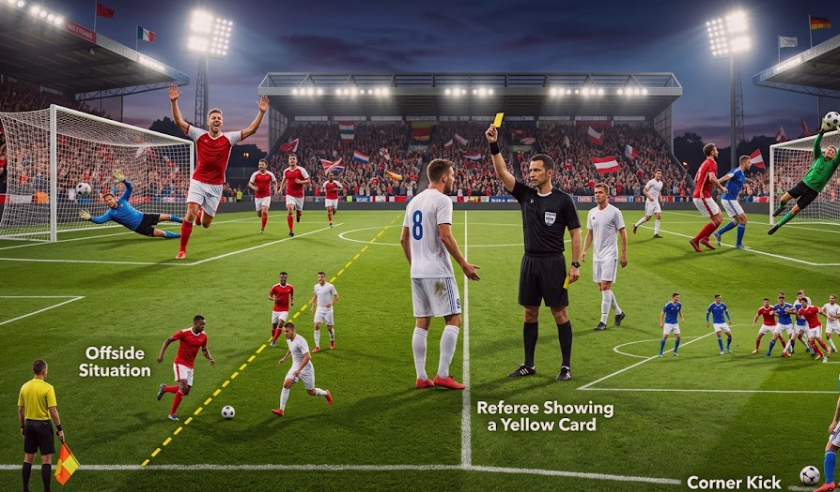
The offside rule, explained (in a way that still feels a bit messy)
The offside rule is frequently treated as the most confusing rule in soccer, and I see why; it does get tangled fast.
A player is offside if they end up
- closer to the opponent’s goal than both the ball and the second-last defender to whom
- Their teammate delivers the ball
In other words, the rule blocks players from lingering near the goalmouth for straightforward scoring moments.
Small example, common situation
A forward stands behind every defender, hanging out close to the net area.
A teammate plays the ball forward.
The forward usually gets flagged for being offside.
Then the referee stops play and awards possession to the opposing team.
To better understand how forwards, midfielders, and defenders use positioning, check out our article Soccer Positions Explained.
What happens if a match ends tied
In plenty of league competitions, the match just ends as a draw, nobody argues much, and everyone moves on.
But in knockout tournaments, it’s different; there has to be a winner.
Sometimes the tie is solved with:
- Extra time
- Penalty shootouts
Extra Time Explained
Extra time is made up of
- Two periods, 15 minutes each, so
30 more minutes total.
If the score is still level, after that, the match continues to penalty kicks.
Penalty Shootouts
In a penalty shootout, each team delivers five attempts.
After those kicks, if the tally is still equal, the game heads into sudden death, meaning the first decisive kick decides everything.
Penalty shootouts are among the most dramatic scenes in soccer.
Want to see how knockout tournaments operate at the highest level? Read our guide on FIFA World Cup Explained.
What is VAR?
VAR means:
Video Assistant Referee
VAR supports match officials when they need to review a key call. It lets them double-check what happened, especially when the moment was close or unclear.
What they commonly review includes
Goals, Penalties, Red cards, and mistaken identity issues
The goal of the system is to make outcomes more accurate and fair.
Basic soccer etiquette
Good sportsmanship is part of soccer culture, not a side detail.
Players are expected to:
- Respect referees
- Respect opponents
- Avoid simulation, meaning diving
- Stick with fair play principles
Respect remains a core value of the sport around the world.
Why knowing soccer rules helps
When you learn the rules, watching matches becomes much more enjoyable.
You’ll understand more clearly
- Tactical choices
- Referee decisions
- Team strategies
- Player positioning
- Match results
Even a small amount of knowledge improves the viewing experience a lot.
Frequently Asked Questions
How many players are on a soccer team?
There are eleven players on the pitch for each team, usually.
How long does a soccer game last?
A normal match runs 90 minutes, plus extra stoppage time added by the referee.
What is the offside rule?
A player may not receive the ball if they are standing beyond the second-last defender when the pass happens.
Can a goalkeeper use their hands?
Yes, but only inside their own penalty area.
What happens after a red card?
The player is dismissed and cannot be swapped or replaced.
Final Thoughts
Getting the soccer rules down for newcomers is one of the first steps toward enjoying the world’s most popular game. Between goals, throw-ins, penalties, and offsides, too, these regulations provide the rhythm and structure that make soccer exciting, reasonable, and highly competitive.
Whether you are watching your first match, keeping up with the FIFA World Cup, or cheering for a club in the UEFA Champions League, understanding the simple rules will make every second on the field feel more real. As you go on learning the sport, you will start to notice why soccer grabs billions of supporters worldwide.