
Soccer Positions Explained is the world’s most popular sport, enjoyed by billions of fans across every continent. While the game objective feels simple, you basically score more goals than the other team, but really, understanding player positions matters a lot to appreciate the tactics and the chemistry behind each match.
Whether you are watching the English Premier League, UEFA Champions League, FIFA World Cup, or your local club, every player has a duty on the pitch. Some players lean into scoring, others handle defending, and others craft opportunities and keep pushing the pace forward, even when the ball is not in the obvious place. If you are new to soccer, terms like goalkeeper, striker, winger, defensive midfielder, and center back might feel confusing. This beginner guide aims to explain each Soccer Positions Explained, what the player does day to day during play, and how they support the team’s success.
Once you finish reading, you should be able to recognize every position on the field and follow any match with real confidence.
How Many Players Are on a Soccer Team?
In a soccer match, a team ends up with 11 players on the pitch. That number is fixed most of the time, yes. There’s 1 goalkeeper, and then 10 outfield players, who handle everything else.
Those outfield players get split into a few roles, like defenders, midfielders, and forwards. Each one has its own set of duties, for when the team is pushing forward, and also when they fall back into defense. Even the smallest job in each area matters, because responsibilities are unique during both kinds of play.
Soccer field positions, kind of explained
A soccer pitch is usually split into four big parts: Goalkeeping area, defense, midfield, and attack. Each slice has players doing their own kind of job, in a way, for what happens on the match day.
- Goalkeeping Area
Defense
Midfield
Attack
Each section has players responsible for different aspects of the game.
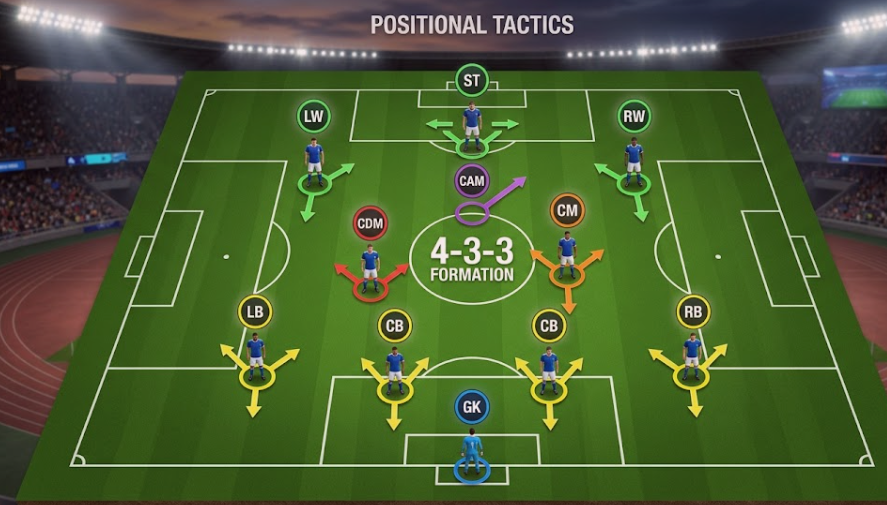
Goalkeeper (GK)
The goalkeeper is the only one allowed to use their hands inside the penalty area. Basically, they’re the last line of safety, so the main duty is keeping the rival from scoring.
Main responsibilities
- Make saves
- Claim or catch crosses
- Help organize the defense
- Begin attacks with sharp passing
- Talk with teammates during play
Modern goalies are also expected to show strong footwork as well, not only stopping shots, but reading the moment.
Skills required
- Fast reflexes
- Solid positioning
- Clear communication
- Smart decisions
- Reliable ball distribution
Defense
Defenders guard the goal and block the opposing team’s attackers. There are multiple roles within the defense.
Center back (CB)
Center backs sit in the center of the defensive line. They’re in charge of
- Stopping strikers, winning aerial battles, and blocking shots
- Making tackles, yes, that’s part of it, pretty normal.
- Clearing dangerous balls is also pretty key.
Most teams work with two center backs, and then they kinda arrange everything else around that.
Full back, LB, and RB, they defend the edges of the pitch.
What they do is mainly:
- Marking wingers
- Blocking the crosses
- Backing up attacks
Overlapping runs, more than you’d expect
Delivering crosses right into the penalty zone
These modern full backs, they add a lot to both defending and offense.
Wing back, LWB, and RWB,
Now those guys go even more toward attacking than the older style full-backs.
Their job is usually:
- Creating scoring chances
- Shutting down wide zones
- Crossing the ball
- Helping the midfield
Wing-backs are often used in setups with three central defenders; it helps balance the shape, and the spacing gets a bit more flexible.
Want to understand how defenders fit into different formations? Read our complete guide, Most Common Soccer Formations Explained.
Midfielders
Midfielders kind of connect the defense to the attack in a steady way. During most matches, they travel the greatest distance, more than anyone else.
Defensive Midfielder (CDM)
The defensive midfielder is positioned in front of the defenders. This role means they are always there to guard the space.
Key responsibilities are:
- Breaking up attacks
- Winning tackles
- Intercepting passes
- Protecting the defense
- Starting counterattacks
This player acts as the team’s defensive shield very often.
Central Midfielder (CM)
Central midfielders tend to control the rhythm of the game. They pass accurately, keep the ball when needed and they also help defend.
They:
- Pass accurately
- Maintain possession
- Create attacks
- Help defend
- Support forwards
Good central midfielders usually have excellent vision and passing ability.
Attacking Midfielder (CAM)
The attacking midfielder plays closer to the forwards, so they can arrive with ideas.
Responsibilities include:
- Creating scoring chances
- Through balls
- Long-range shooting
- Assists
- Linking midfield with attack
This role often produces the team’s most creative player.
Learn how midfielders control the game in our beginner’s guide, How Soccer Formations and Tactics Work.
Forwards are the part of a team that tends to score goals, a lot.
In general, different advanced attacking spots come with their own jobs, so the same player cannot just do everything at the same time.
ST or Striker
The striker is usually the team’s main goal scorer, and yeah, that role matters.
Their responsibilities:
- Finishing chances, making attacking runs
- Holding up the ball when pressure comes in
- Pressing defenders so they hesitate
- Heading crosses into the danger zone
A bunch of legendary soccer players have excelled in this role, no surprise.
Center Forward or CF
A center forward mixes goal scoring with playmaking, then steps into the flow of the attack.
Often they:
- Drop deeper into midfield
- Create opportunities for others
- Link up the moves after a turnover
- Score goals when the timing is right
Wingers or LW & RW
Wingers operate on the left and right edges of the attacking line.
Their responsibilities usually include:
- Dribbling past defenders and forcing mistakes
- Delivering crosses with quick timing
- Cutting inside to shoot rather than only crossing
- Creating assists for teammates
- Stretching the defense so gaps appear
- Fast, skillful players tend to work as wingers.
Second Striker
Some teams deploy a second striker just behind the main striker, like a clever shadow role.
That player:
- Creates chances with clever timing
- Scores goals when the defense shifts
- Finds space between midfield and the back line
Links midfield and attack without slowing everything down
Want to learn how attackers score from different situations? Check out our guide, Soccer Rules Explained: A Beginner’s Guide.
Common Soccer Formations, kinda
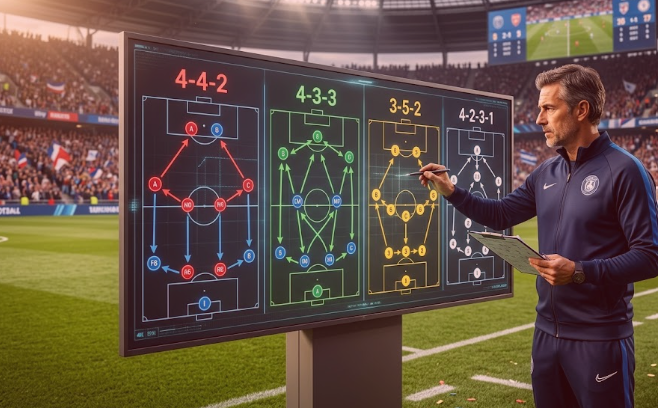
Player placements change depending on the team’s formation,and it can get a bit confusing in the middle of a match.
Some popular arrangements are
- 4-4-2
- 4-3-3
- 4-2-3-1
- 3-5-2
- 5-3-2
Every setup shifts the duties of the players in small but noticeable ways, like how the spacing feels. For instance,
- A 4-3-3 leans on wide wingers.
- A 3-5-2 leans on wing-backs a lot.
- A 4-2-3-1 brings extra midfield governance.
Learn why coaches choose different systems in our article, Most Common Soccer Formations Explained.
Why every position matters
So soccer feels like the ultimate team sport, for real.
Each player contributes in a different way, even if the roles look similar during play.
- If you leave out defenders, the team will concede goals.
- If you remove midfielders, the team has trouble with control of possession.
- If the forwards are missing, the team can’t score, not in a consistent manner.
Even the goalkeeper sometimes begins attacking moves, not just saves.
In the end, success leans more on teamwork than on individual brilliance alone.
Picking the right soccer position
If you’re new to playing soccer then choosing a position is mostly about your strengths and how you like to play.
Goalkeeper
Best for players who have:
- Quick reflexes
- Confidence
- Communication skills
- Defender
Usually a good fit if you enjoy:
- Tackling
- Reading the game
- Physical play
- Midfielder
Perfect for players who:
- Like passing
- Have solid stamina
- Enjoy managing possession
- Forward
Great for players who:
- Love scoring goals
- Have pace
- Feel confident in one-on-one situations
Frequently Asked Questions
How many positions are there in soccer?
In soccer there are 11 playing positions, including a goalkeeper and ten players out on the field
Which soccer position scores the most goals?
Mostly it’s the striker who ends up with the most goals , because that role is tied to finishing chances
What is the hardest position in soccer?
A lot of coaches think central midfielder is one of the hardest jobs, because it demands both offense and defense, quick passing decisions, and top level endurance. Also, the pace is usually constant
Can players change positions during a match?
Yes, players do shift roles during play. Modern teams often rearrange players based on tactics, momentum, and game situations
Which position runs the most?
Midfielders typically end up running the farthest distance across the match, since they connect defense to attack
Why are formations important?
Formations guide where players begin on the pitch. They also shape how everyone coordinates when attacking and when defending, sometimes affecting spacing, pressure, and passing angles
Conclusion
Getting a handle on Soccer Positions Explained is basically the first step toward becoming a knowledgeable fan. Every player on the pitch has a specific role, from the goalkeeper guarding the goalmouth to the striker who turns chances into real finishes. Defenders bring a kind of steadiness, midfielders manage control of the ball, and forwards create energy with goals and also assists, depending on what the match needs.
As you keep watching more games, you’ll start seeing how the different spots collaborate, and how tactics can sway the result of the contest. Whether you’re just getting started or you also dream of playing someday, understanding these jobs will make soccer feel completely different, in a good way.