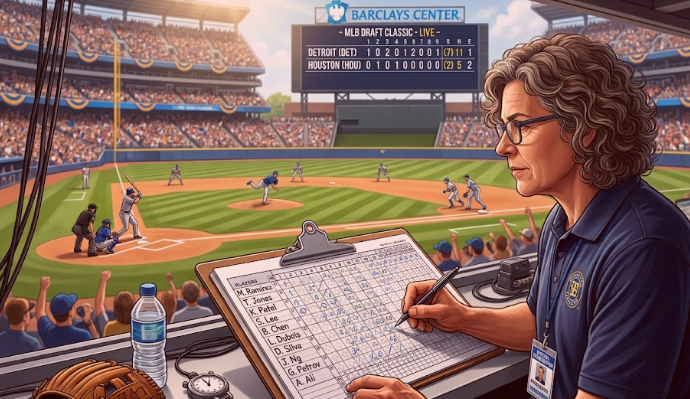

If you have ever watched a baseball game on television and wondered how players score runs or why scorekeepers use so many symbols and notations, you’re not alone. Baseball Scoring Explained is a topic that may seem confusing at first, but once you understand the basics, it becomes one of the most interesting aspects of the game. Learning how runs are scored and how scorekeeping works will help you follow every inning with greater confidence and enjoy the sport even more.
Unlike most other sports where points are made right away, baseball scoring requires certain strategies and the recording of every single play by the scorekeepers. It doesn’t matter whether you are a fan, a young player, a parent or you play for fun in fantasy baseball or learn it for coaching, baseball scoring will make you enjoy every single inning of the game.
This article will provide you with all the information you will need about baseball scoring.
If you’re new to the sport, read our Complete Guide to Baseball Rules for Beginners before learning how scoring works.
What Is Baseball Scoring?
The system by which all the actions are recorded in the game while keeping track of the number of runs scored by each team is called baseball scoring.
The main aim of baseball is clear-cut:
To score more runs than the opponent team before the game is over.
Both teams are given an opportunity to bat in every inning while trying to score runs by sending players from one base to another.
A completed circuit of bases earns a run for the team.
The team with the highest score at the end of nine innings (or more if required) emerges victorious.
Understanding Runs in Baseball
Run is the only way to earn points in baseball.
The player earns runs by touching:
- First Base
- Second Base
- Third Base
- Home Plate
without getting out.
E.g.:
Suppose that the batter makes a double.
Next, the batter makes a single, which helps the runner reach the third base.
After that, the runner reaches the home plate thanks to a sacrifice fly.
This player scores one run.
The runs are accounted for the team regardless of whose hit has brought it.
What are RBIs?
RBI is an abbreviation for Runs Batted In.
The batter is said to have earned an RBI if his hit or action helped another player score.
It may be:
- Single bringing a runner home
- Double helping to drive in two runners
- Home run
- Sacrifice fly
- Bases-loaded walk
E.g.:
The bases are loaded.
The batter makes a single.
Two runners score.
The batter earns 2 RBIs.
But RBIs do not go to the batter in each case.
Learn more about offensive baseball statistics in our Guide to Baseball Batting Statistics.
How Players Circulate the Bases
Every player begins his game from home plate.
In order to score, he must circulate the bases safely.
The four bases consist of:
- Home plate
- First base
- Second base
- Third base
- Home plate again
Methods of moving on bases include:
- Hit
- Walk
- Steal of bases
- Wild pitch
- Passed ball
- Errors of defense
- Fielder choice
A player reaches home plate once more and scores a run.
Kinds of Hits That Impact the Scoring System
Various kinds of hits help the runners reach different distances on the field.
Single
The batter reaches first base.
Double
The batter reaches second base.
Triple
The batter reaches third base.
Home Run
The batter completes a round of all four bases.
All runners at base score too.
For instance:
- Bases loaded
- Batter hits a home run
Consequence:
- Four runs scored
- Batter gets four RBIs
This hit is called a Grand Slam.
What Is a Home Run?
A home run is one of the easiest scoring methods in baseball to comprehend.
Whenever the batter hits the ball beyond the outfield fence in fair territory without any defensive interference, they will get an automatic score upon touching all the bases.
In case there were players on the bases, each one of them scores as well.
Examples
- Single Home Run = 1 Scored
- Two-run Home Run = 2 Scored
- Three-run Home Run = 3 Scored
- Grand Slam = 4 Scored
Home runs are some of the most thrilling plays in the game since the team’s score is instantly increased.
How Innings Influence Scoring
A standard baseball game usually includes nine innings.
An inning has two parts:
- Top of the inning
- Bottom of the inning
Both teams get a chance to bat once per every inning.
The batting team can continue scoring until they have recorded three outs.
After recording three outs, the teams interchange positions.
This pattern is repeated for the entire game.
Understanding the Baseball Scoreboard
A typical baseball scoreboard displays:
- Runs (R)
- Hits (H)
- Errors (E)
- Innings
- Current score
- Balls
- Strikes
- Outs
Example:
| Team | R | H | E |
|---|---|---|---|
| Home | 6 | 11 | 1 |
| Away | 4 | 8 | 2 |
This means:
- Home team scored 6 runs
- Collected 11 hits
- Made 1 defensive error.
What Is Baseball Scorekeeping?
Scorekeeping involves noting each play during the baseball game.
The official scorer makes use of a scorecard for scoring:
- Hits
- Outs
- Strikeouts
- Walks
- Errors
- Runs
- RBIs
- Pitcher substitutions
Even as electronic scorekeeping has become popular, many baseball fans still prefer to keep score manually.
It helps in watching all the aspects of the game.
Explore our Baseball Scorekeeping Symbols and Scorecard Guide to learn how to keep score like a professional.
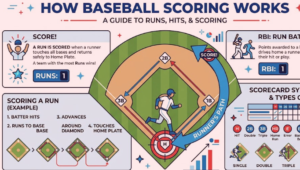
Baseball Scorekeeping Symbols
Some common baseball abbreviations used on scorecards are:
- K – strike out
- BB – walk
- HBP – hit by pitch
- HR – home run
- 1B – single
- 2B – double
- 3B – triple
- E – error
- SB – stolen base
- CS – caught stealing
- DP – double play
These symbols help one interpret scorecards easily.
Effects of Errors on Scoring
Each run does not score as a result of a hit.
Sometimes mistakes can be made by the defense team.
This means that an error is when a player cannot complete a routine play.
Illustration:
- The ground ball passes between the short stop’s legs.
- The batter gets to first base safely.
- An error is recorded in the scorecard rather than a hit.
Later errors can result into scoring runs but they might be regarded as unearned runs.
Earned Runs and Unearned Runs
The performance of pitchers is measured by earned runs.
Earned Run
A run scored without defensive assistance.
Unearned Run
A run scored due to defensive errors.
Such terminology impacts a pitcher’s ERA (Earned Run Average).
Walk-off Wins
Walk-off means a win for the home team by scoring a run during the bottom half of the last inning.
Since the home team takes the lead right away, the game ends abruptly.
Includes:
- Walk-off single
- Walk-off home run
- Walk-off sacrifice fly
Walk-offs are one of the most exciting things in baseball.
Extra Innings
In case of a tie at the end of the nine innings, the game enters extra innings.
The teams keep playing full innings till one of the teams completes its inning with a higher score compared to that of the other.
There is no regular game time constraint for the number of innings played.
Why Baseball Needs Thorough Scoring
Unlike many other sports, baseball monitors almost everything done by the players.
Thorough scoring is important for:
- Player evaluation
- Calculation of statistics
- Strategy analysis
- Record keeping
- Coaching
All statistics such as batting average, ERA, OPS, and slugging percentage depend on proper scoring.
Tips to Learning Baseball Scorekeeping
Firstly, don’t attempt to learn all rules of baseball scorekeeping immediately.
Instead, do the following:
- Learn about run-scoring.
- Learn about purposes of bases.
- Observe the scoreboard during a baseball match.
- Learn to read a baseball scorecard.
- Observe one particular player during an inning.
- Score during an actual game in order to gain experience.
The more matches you observe, the easier baseball scorekeeping becomes for you.
Continue learning with our Complete Baseball Positions Guide to understand each player’s role on the field.
Frequently Asked Questions
How many runs does a home run score?
At least one run. If there are runners, a home run scores additional runs based on the number of runners crossing the plate.
Does every hit earn an RBI?
Not necessarily. In order for a batter to earn an RBI, he or she needs to help to score the run.
What is the maximum number of runs for one hit?
Four runs, achieved by hitting a grand slam.
What is the difference between a run and RBI?
One run goes to the player that crossed the plate, while RBI is awarded to the batter for driving in that run.
Can a player score runs without having a hit?
Yes. Runs can be scored through reaching bases via walk, hit by pitch, error or fielder’s choice.
Conclusion
Comprehension of baseball scoring can completely change your perception about the game. Although it may look complicated initially, baseball scorekeeping essentially helps in recording each event that occurs during the game and also in determining how players score runs. Knowing some basic rules about runs, RBIs, innings, scorecards, and other common scorekeeping symbols will help you enjoy every game.
Whatever the case whether you are a coach of a youth team or a spectator of Major League Baseball games, learning about baseball scoring is vital for you if you want to become a good baseball fan. With frequent practices and watching live baseball games, you can soon become a good scorecard reader.