
Baseball is one of the most recognizable and beloved sports in the United States. While the game may seem confusing at first, learning the baseball rules for beginners makes it much easier to understand and enjoy. Once you become familiar with the basic rules, such as innings, strikes, outs, and how teams score runs, you’ll quickly appreciate the strategy and excitement that make baseball one of America’s favorite pastimes.
Whether you’re watching your first MLB game or following your favorite team throughout the season, understanding the fundamentals will help you enjoy every pitch and every play.
This beginner’s guide provides Baseball Rules for Beginners, the scoring system, innings, outs, and other terms and concepts that every newcomer should know.
If you’re unfamiliar with where players line up on the field, check out our MLB Positions Explained guide to learn the role of every defensive position before diving into the rules.
Baseball Game Description
Baseball is a bat and ball game which is played by two sides each consisting of nine players.
A baseball game is played on a diamond-shaped ground consisting of four bases:
- Home plate
- First base
- Second base
- Third base
The goal of the game is clear:
One side will try to make runs by batting the ball and then running along the bases, while the other side will try to make outs and prevent the scoring of runs.
Once both sides get the opportunity to bat in an innings, they will switch sides.
Purpose of Baseball
The purpose of baseball is to get more runs than the opposing team.
In baseball, a team gets a run if a player manages to get to:
- First base
- Second base
- Third base
- Home plate
Every player who successfully circles all four bases earns one run for their team.
At the end of the game, the team with the most runs wins.
Understanding the Baseball Field
A baseball field can be described as comprising two primary sections:
Infield
The infield comprises:
- Home Plate
- First Base
- Second Base
- Third Base
- Mound
Most of the defense happens here, where force outs and double plays take place.
Outfield
Outside the infield lies the outfield.
It is made up of:
- Left Field
- Center Field
- Right Field
The outfielders cover wide areas in an effort to catch the fly balls.
To learn what every player does on the field, read our MLB Positions Explained article.
Baseball Equipment
All baseball games require some equipment that is mandatory for each game.
Baseball
It is a small white ball made of leather.
Bat
The attacker uses a bat to strike the ball.
Gloves
All defenders use gloves to catch and field the ball.
Helmet
Batters wear helmets while batting to ensure their safety.
Protective gear
For catchers, the protective gear includes:
- Chest protector
- Shin guards
- Catchers’ mask
Innings in Baseball
A baseball match is made up of nine innings.
These innings have two segments:
Top Half of an Inning
Visiting team takes its turn to bat while the home team pitches.
Bottom Half of an Inning
Home team takes its turn to bat while the visiting team pitches.
An inning finishes once the defending team completes three outs.
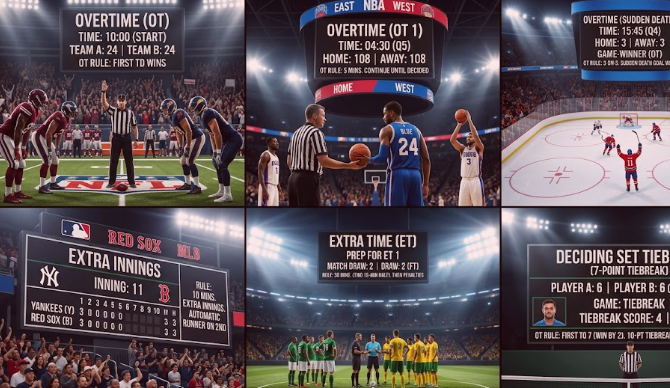
In case of a tie after nine innings, the game goes on into additional innings until one side gets more runs than the other during that inning.
Out in Baseball
An out is one of the most critical concepts in baseball.
The defending team needs to complete three outs before the roles of offense and defense change.
There are various ways to complete an out, including:
- Striking out the batter.
- Catching a hit ball in the air.
- Throwing the ball at a base before the runner gets there.
- Touching a runner with the ball.
All innings comprise six outs—three for each team.
Balls, Strikes, and the Count
Each at-bat starts with a count of 0-0.
The pitcher is trying to get strikes, and the batter is trying to get good pitches to hit.
What Is a Strike?
A strike is called if:
- batter swings and misses.
- batter does not swing at a pitch that is in the strike zone.
- hits a foul ball (under specific conditions).
A third strike causes an out by strikeout.
What Is a Ball?
A ball is called if the pitcher throws a pitch that is outside the strike zone, and the batter does not swing.
If a batter gets four balls, they get a walk and go to first base automatically.
How Teams Score Runs?
Running the bases is quite easy once you know how to do it.
The batsman attempts to reach first base by hitting the ball.
Once he reaches there, he keeps running to:
- Second base
- Third base
- Home plate
Every individual reaching home plate scores one run for his team.
The different ways to score runs are:
- Singles
- Doubles
- Triples
- Home runs
- Sacrifice flies
- Defensive errors
The team scoring the maximum runs wins the game.
What Is a Home Run?
There is nothing like a home run in the game of baseball.
A home run is scored when the batter manages to hit the ball beyond the outfield fence while still within the boundaries of fair territory.
It results in:
- One run (solo home run)
- Two runs
- Three runs
- Four runs (grand slam)
Grand slams are some of the most momentum-altering plays in the game of baseball.
Once you understand the basic rules, learn how these exciting moments become even more important during the postseason by reading our How the MLB Playoffs Work guide.
How a Batter Is Often Retired
The fielding side must record three outs in order for a half-inning to be concluded. There are several different methods by which a batter or a runner can be retired.
Strikeout
The batter will have struck out if he or she receives three strikes during his or her at-bat.
One of the most prevalent ways through which a pitcher gets an out is through a strikeout.
Fly Out
In the case where a player on the defensive side catches a hit ball before it lands on the playing surface, then the batter is declared out.
Both outfielders and infielders register fly outs during a game.
Force Out
This refers to a situation whereby a runner is forced to run towards the next base, and the defensive team tags that base with the ball before the runner gets there.
For instance, when the batter hits a ground ball and the first baseman touches first base before he does, the batter will be called out.
Tag Out
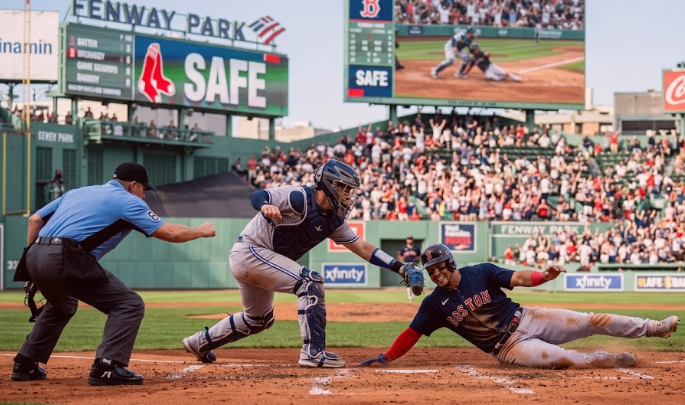
This occurs when a defensive player tags the runner with the baseball (or the glove containing the ball) when the runner is not standing on a base.
Baserunning Rules
Baserunning is an important aspect of baseball strategy.
Following contact with the ball, the batter is then a runner trying to get to the bases safely.
The runner is allowed to:
- Get from one base to another.
- Go to additional bases if he hits a long ball.
- Steal a base when the pitcher is pitching the ball.
- Make it back to home base to score.
The runner could also be called out due to defensive plays made against him.
Effective baserunning could make the game.
Fair Ball and Foul Ball
The first rule that a new fan needs to learn is the difference between a fair ball and a foul ball.
Fair Ball
A fair ball goes into the foul lines that go from the home plate to the first base and third base.
The play goes on, enabling players to advance.
Foul Ball
A foul ball goes outside the foul lines.
Most foul balls count as a strike for the hitter if he does not have two strikes yet. But a player cannot be declared as striking out by hitting a regular foul ball if he has already two strikes (unless in certain conditions like a foul bunt).
Terms in Baseball You Need to Know If You Are a Newbie
As you continue to follow baseball games, you will notice that there are certain words that commentators keep using again and again.
Some of the most popular ones include:
- Single – When the batter gets to the first base after hitting.
- Double – When the batter manages to go to the second base.
- Triple – When the batter gets to the third base.
- Home Run – When the batter runs all four bases and scores after a hit.
- Walk – After the batter gets four balls.
- Strikeout – When the batter gets three strikes.
- Bullpen – Where pitchers warm up.
- Double Play – Two outs scored at once.
- Extra Innings – Extra innings played when there is a tie at the end of nine innings.
Knowing these terms will be helpful for you.
Frequently Asked Questions
How long does a baseball game take?
A regular game in the MLB takes place in nine innings. The actual playing time depends on the speed of the game, but usually lasts 2½ to 3 hours.
How many people are there on a baseball team?
There are nine players on the playing field at any moment, even though each team has more players.
How can you win a baseball game?
In order to win a game, you have to score the highest number of runs by the end of the game. In case of a tie, extra innings are played until one team wins an inning with a higher score.
What happens if the batter gets four balls?
When a batter gets four balls, he or she is awarded first base. It is also called a walk or base on balls.
What is a strike zone?
Strike zone is the area over home plate, which is the area between the knees and the middle of the chest of the batter. When a pitch hits the strike zone without a swing, it is considered a strike.
Closing Thoughts
One of the best ways to enjoy one of the most historical and strategic games in America is by learning how to understand the fundamental rules of baseball. While baseball can be difficult to comprehend for the first time, it becomes easier once you learn about innings, outs, strikes, balls, and how to run bases.
Watching more baseball games will teach you how to understand the reasons behind every pitch, defensive moves, and offense choices. Whether it’s an amazing home run or a well-executed double play, everything is much more interesting when you understand the rules of the game.
Interested in discovering where baseball ranks among America’s favorite sports? Check out our Most Popular Sports in the USA article.